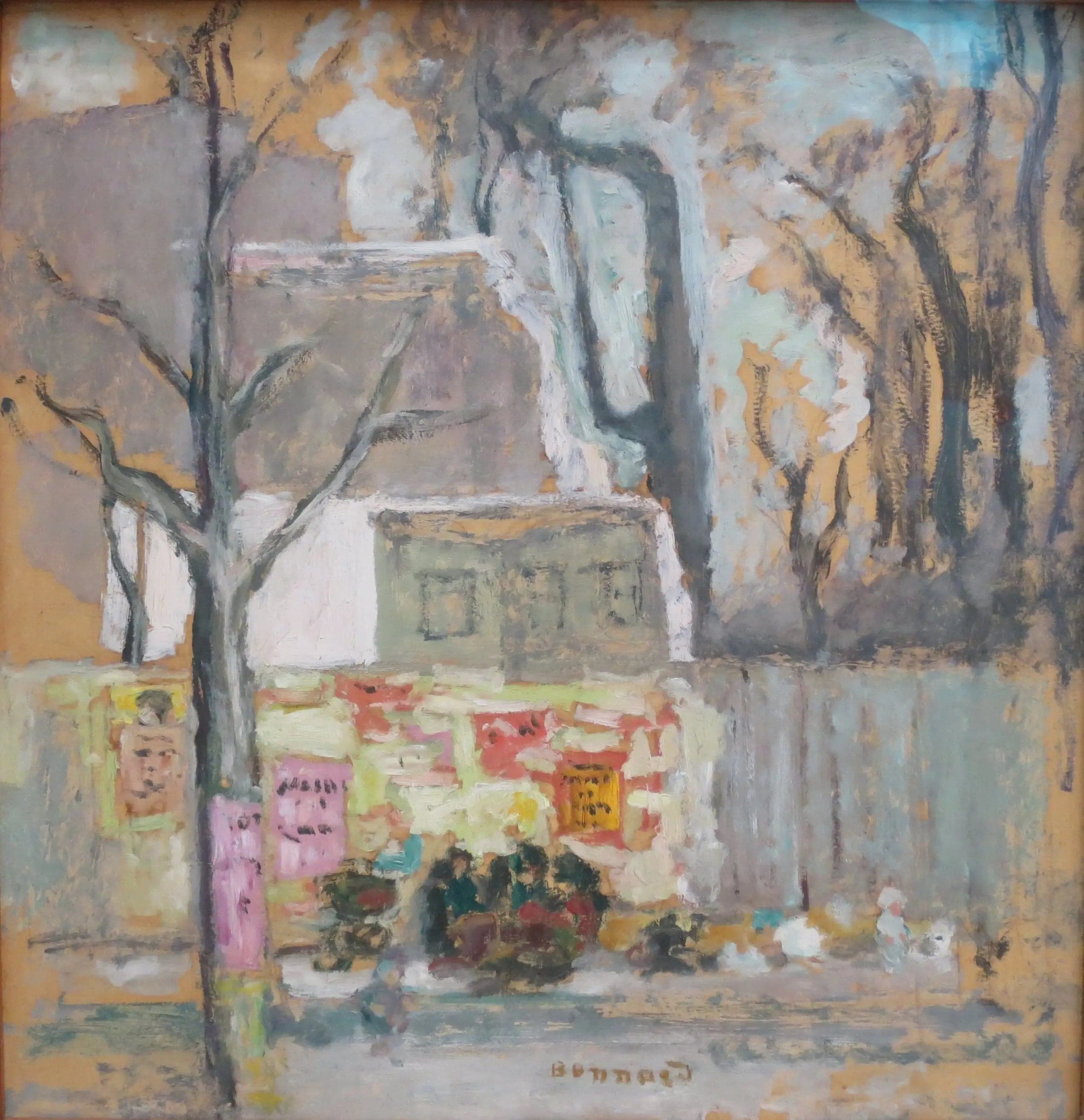
Piece of Paris
- Original dimensions
- 51.8 x 49.2 cm
- Museum
- Hermitage Museum
- Year
- 1905
Scene depicted
In the painting “Piece de Paris,” an interior scene unfolds, blending animated characters in a delicate space, harmonizing light and shadow. The composition seems to freeze a moment of life, where every detail is an invitation to dive into the intimacy of human relationships. The painting evokes a warm, almost tangible atmosphere, where the silence of the Parisian home intertwines with the sounds of the city.
Historical context
Created in 1905, in the vibrant heart of France, Piece de Paris is an iconic painting representing the beginnings of the Nabi movement. This painting, exhibited at the Hermitage Museum , reflects Bonnard's artistic sensitivity, one of the masters of color and light of his time. It is through this canvas that one discovers the Parisian life of that time, with dimensions that give it a tangible presence in any interior.
Place in the artist's career
Piece de Paris represents a pivotal phase in Bonnard's career. Between the boldness of his early works and the mastery of his style, this painting reveals an important turning point, parallel to creations like “Le Déjeuner” and “La Terrasse à Vernon,” illustrating his journey towards an increasingly liberated expression.
Anecdote
“Every painting tells a story, and for me, every color is a note of music,” one might imagine Pierre Bonnard saying. Inspired by the soft lights of spring in Paris, one morning, while strolling along the alleys, he wanted to capture the very essence of life. This pictorial work thus becomes a sensitive echo of those intimate moments, vibrating under the rays of the sun.