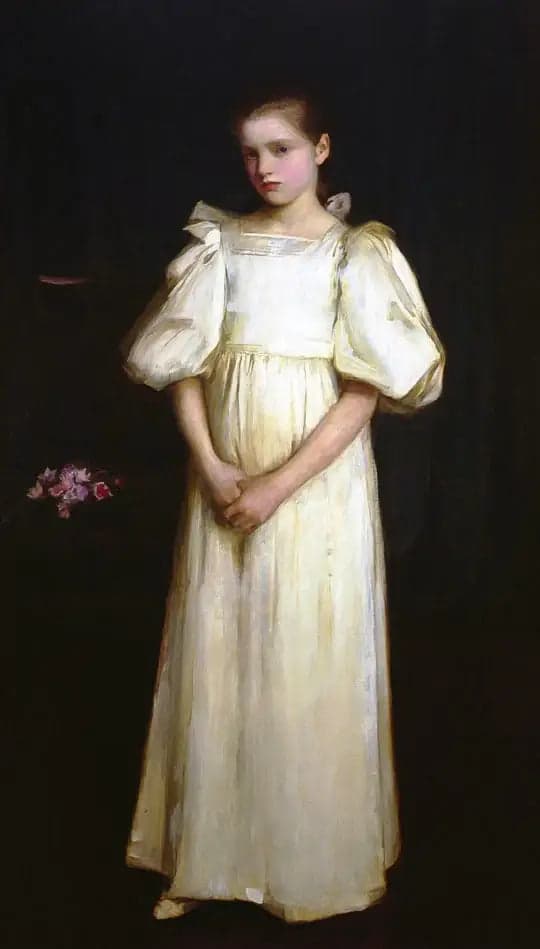
Phyllis Waterlow, EQ Waterlow's younger daughter
Scene depicted
This painting beautifully designed depicts Phyllis Waterlow surrounded by lush nature, evoking the captivating beauty of Victorian gardens. The young woman, in a delicate pose, appears lost in her thoughts, reflecting a moment of introspection where the harmony between humanity and nature is palpable. The refined details of her clothing and the surrounding floral elements reinforce the idea that beauty lies in the small things in life.
Historical context
Created in 1897 in London, this iconic work belongs to the Pre-Raphaelite movement, which aims to rediscover the illustrative techniques of the old masters. Located in the British capital, this painting bears witness to a time of artistic and cultural renewal. Currently, this painting is preserved at the Liverpool Museum, where visitors can admire its beauty in all its splendor. Its dimensions, of proportional elegance, extend to 91 x 60 cm.
Place in the artist's career
This masterpiece marks a pivotal moment in Waterhouse's career, illustrating the mastery of subtle lighting and classical themes. Like his other paintings such as “La Belle Dame Sans Merci” and “Ulysses and the Sirens,” this masterpiece reflects a notable technical progression. The enveloping light, the expressiveness of the characters, and the harmonious composition reflect an artist at his peak.
Anecdote
“Beauty is a melody that only the eye can hear,” Waterhouse once confided, reminiscing about the moment he observed the soft light filtering through the branches above a secret garden. It is this same glow that resonates in the painting “Phyllis Waterlow,” making this canvas an ode to femininity and elegance.