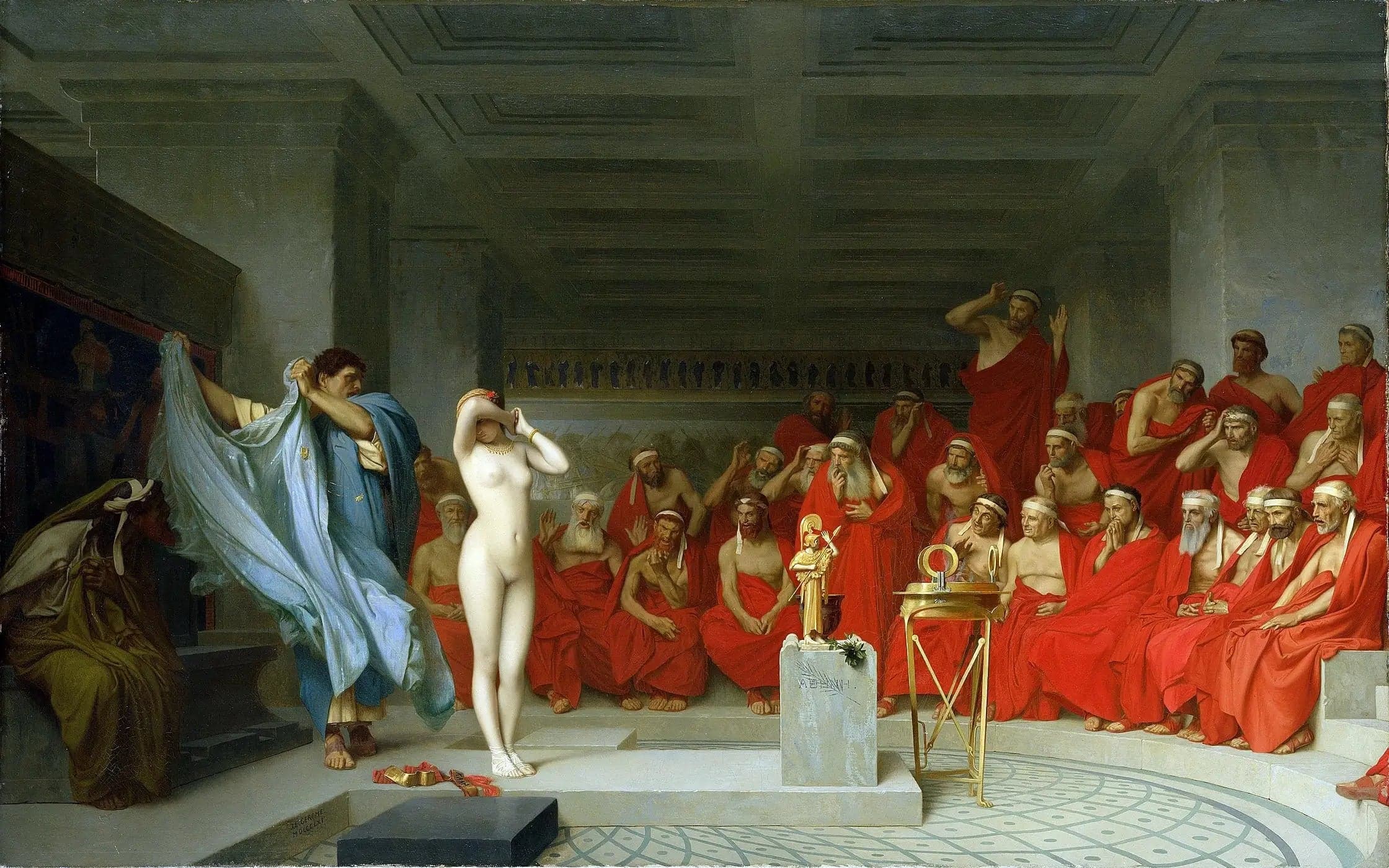
Phryne before the Areopagus - Jean
- Original dimensions
- 128 x 80 cm
- Movement
- academicism
- Museum
- Hamburg Kunsthalle
- Year
- 1861
Scene depicted
The canvas , emblematic of Greek culture, depicts Phryné, a famous courtesan, standing confidently before a tribunal of men. The palpable tension and eloquence of her speech refer to the struggle for justice and the importance of aesthetic values. Gérôme infuses this scene with a vitality that transcends time.
Historical context
Created in 1861, the painting Phryné before the Areopagus by Jean-Léon Gérôme is at the heart of academicism , a movement that defends realism and technical rigor within the visual arts. At that time, the city of Hamburg, where this painting is currently located, is a vibrant artistic center. This masterpiece, with its imposing dimensions of 128 x 80 cm, captured the collective imagination by evoking the mysteries of ancient Greece.
Place in the artist's career
This painting marks a turning point in Gérôme's career, merging his obsession with classical themes and his desire for perfection. Through notable works such as The Gladiator and The Dance of the Dervishes , we observe how his style matures, and his ability to capture human essence gradually refines.
Anecdote
Jean-Léon Gérôme , passionate about ethics and beauty, once declared: "Truth is beauty, but it must be painted." This magical moment of creation is said to have occurred one spring morning, when the artist, inspired by a marketplace on the street, observed faces emerging from the shadows of an ancient world, bringing to life the painting we admire today.