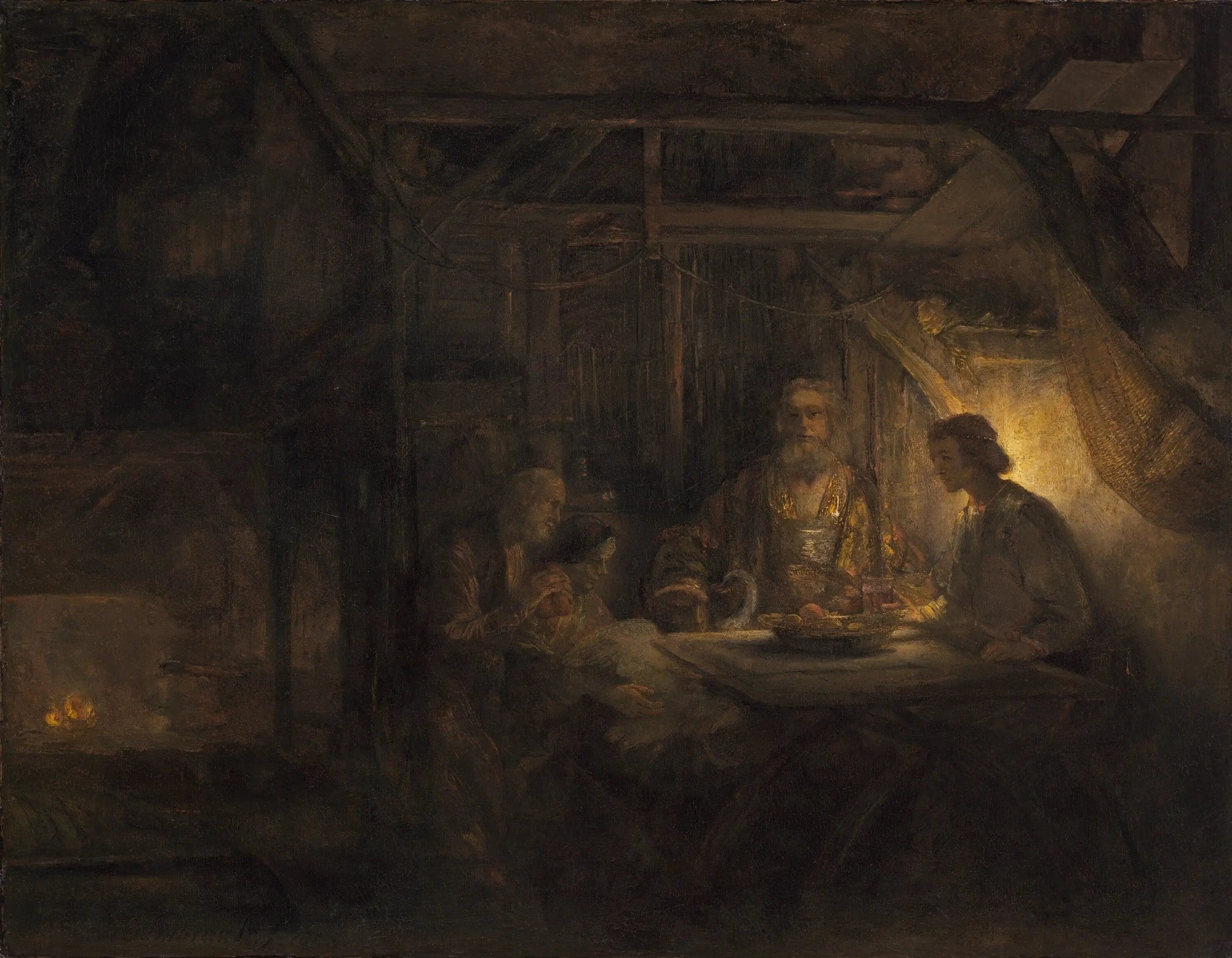
Philemon and Baucis
- Original dimensions
- 68.5 x 54.5 cm
- Museum
- National Gallery of Art
- Year
- 1658
Scene depicted
This painting illustrates the legendary hospitality of Philémon and Baucis, an elderly couple, who welcome Jupiter and Mercury disguised as travelers. Their generosity is rewarded by the transformation of their humble home into a glorious temple, a striking metaphor for the beauty of their hearts. Every meticulous detail is an ode to the power of compassion.
Historical context
Created in 1658, this painting is located in Amsterdam, a vital center of Dutch culture during the Golden Age. The artistic movement of baroque , with its taste for drama and light, envelops this canvas , known for its striking narrative. Currently, the painting is displayed at the National Gallery of Art , where it is admired by art enthusiasts from around the world.
Place in the artist's career
“Philémon et Baucis” represents a period of maturity in the career of Rembrandt , echoing other paintings such as “The Night Watch” and “The Anatomy Lesson of Dr. Tulp.” These works testify to a refined technical evolution, illustrating the artist's growing mastery in the use of light and shadow to express deep emotions.
Anecdote
“Beauty lies in the simplicity of exchanges,” could have said Rembrandt one spring morning, as he observed the daily life of the inhabitants of Amsterdam. This moment of clarity inspired the evocative power of this pictorial work , where Philémon and Baucis welcome deities under the golden glow of the sun.