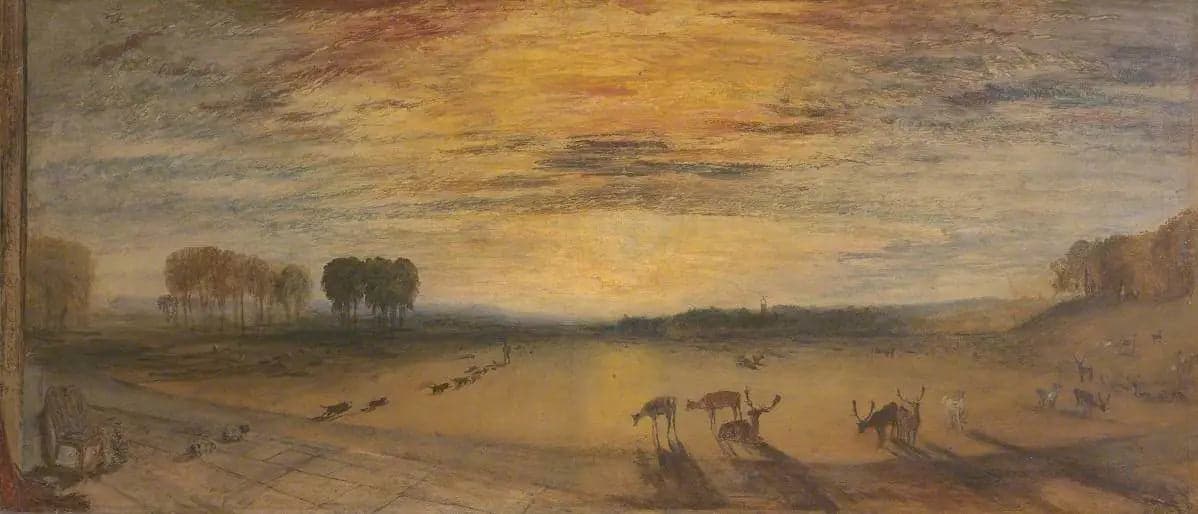
Petworth Park: Tillington Church in the Distance
- Original dimensions
- 60 x 145.7 cm
- Museum
- Tate
- Year
- 1828
Scene depicted
The painting “Petworth Park: Tillington Church in the Distance” depicts a view of the iconic park, where the tranquil silhouette of Tillington Church stands majestically in the distance. This composition highlights the harmonious marriage between wild nature and human refuge, revealing a peaceful atmosphere enriched by the delicate play of light that Turner knows how to capture so well. The tall trees, the evanescent clouds, and the winding path invite a meditative stroll, immersing the viewer in infinite contemplation.
Historical context
Created in 1828, this painting is emblematic of one of the masters of English Romanticism , Joseph Mallord William Turner , finds its origin in the idyllic setting of Petworth Park, located in the heart of Sussex, England. This was at a time when landscape and light were becoming the main actors in pictorial work, at the dawn of the Impressionist movement. Today, this canvas is preserved in the Tate museum, testifying to a time when art flourished in perfect harmony with nature.
Place in the artist's career
This painting , imbued with Turner’s visual boldness, marks a decisive turning point in his career, showcasing an unparalleled stylistic mastery. Alongside “The Landing of the Queen of Sheba” and “Rain, Steam and Speed,” this canvas concludes a period of artistic maturation, brushing against the transition to abstraction through the use of light and color.
Anecdote
“Light is both the key and the end of all painting ” Turner might have said while contemplating one spring morning, the fertile landscape awakening under the gentle breath of the breeze. This moment of inspiration, this embrace between earth and sky, is intensely captured in this masterpiece , elevating the simple view of the village of Tillington to a cyclical experience of untainted beauty.