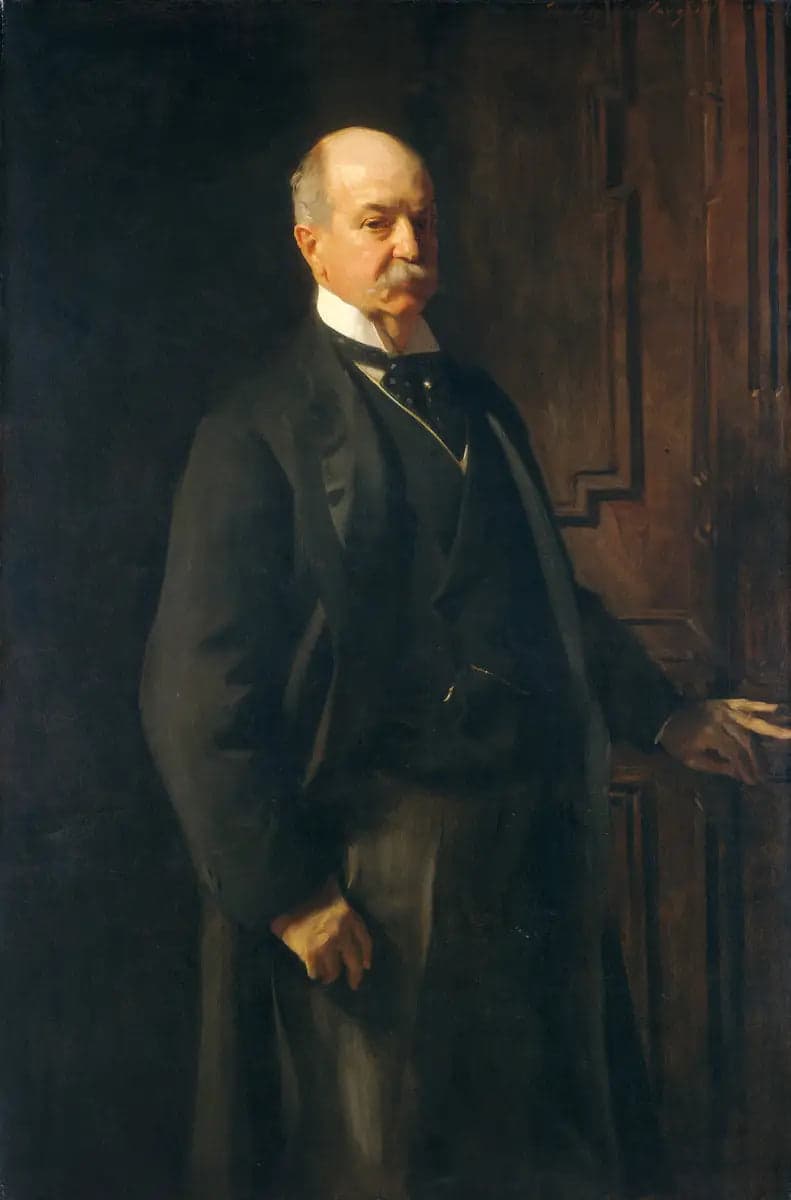
Peter A. B. Widener
- Original dimensions
- 98.4 x 148.9 cm
- Museum
- National Gallery of Art
- Year
- 1902
Scene depicted
The painting, depicting the wealthy philanthropist Peter A. B. Widener, displays a wealth of details that illuminate the imposing stature and complex personality of its subject. The luxurious fabrics, delicate furniture, and soft shadows tell a story of grandeur and intimacy; each brushstroke paints the portrait of an admired man, anchored in a time of prosperity.
Historical context
Created in 1902, the painting emblematic of John Singer Sargent , “Peter A. B. Widener”, unfolds through the innovative canvas of the time, Ottoman and cosmopolitan, at the heart of the city of Washington D.C., while reflecting an opulent artistic movement characteristic of the early 20th century. This masterpiece, now exhibited at the National Gallery of Art , bears witness to a significant moment in the history of American art, merging technique and emotion, while achieving dimensions of 98.4 x 148.9 cm that capture the eye of visitors.
Place in the artist's career
“Peter A. B. Widener” positions itself in Sargent's career as a mark of maturity, successively after works like “Carnation, Lily, Lily, Rose” and before the famous “Queen Mary.” This canvas illustrates a stylistic turning point, demonstrating unparalleled mastery in the interaction of light and textures, a step towards a greater realism that would redefine his approach to portraiture.
Anecdote
Recognized for his sensitivity and unique approach, Sargent once shared: “The painting must capture the soul of a man as much as his appearance.” It is this principle that inspired the creation of this canvas , shaped on a sunny morning, where the soft light enveloped the scene, revealing the warm nuances of colors, like a breath of spring.