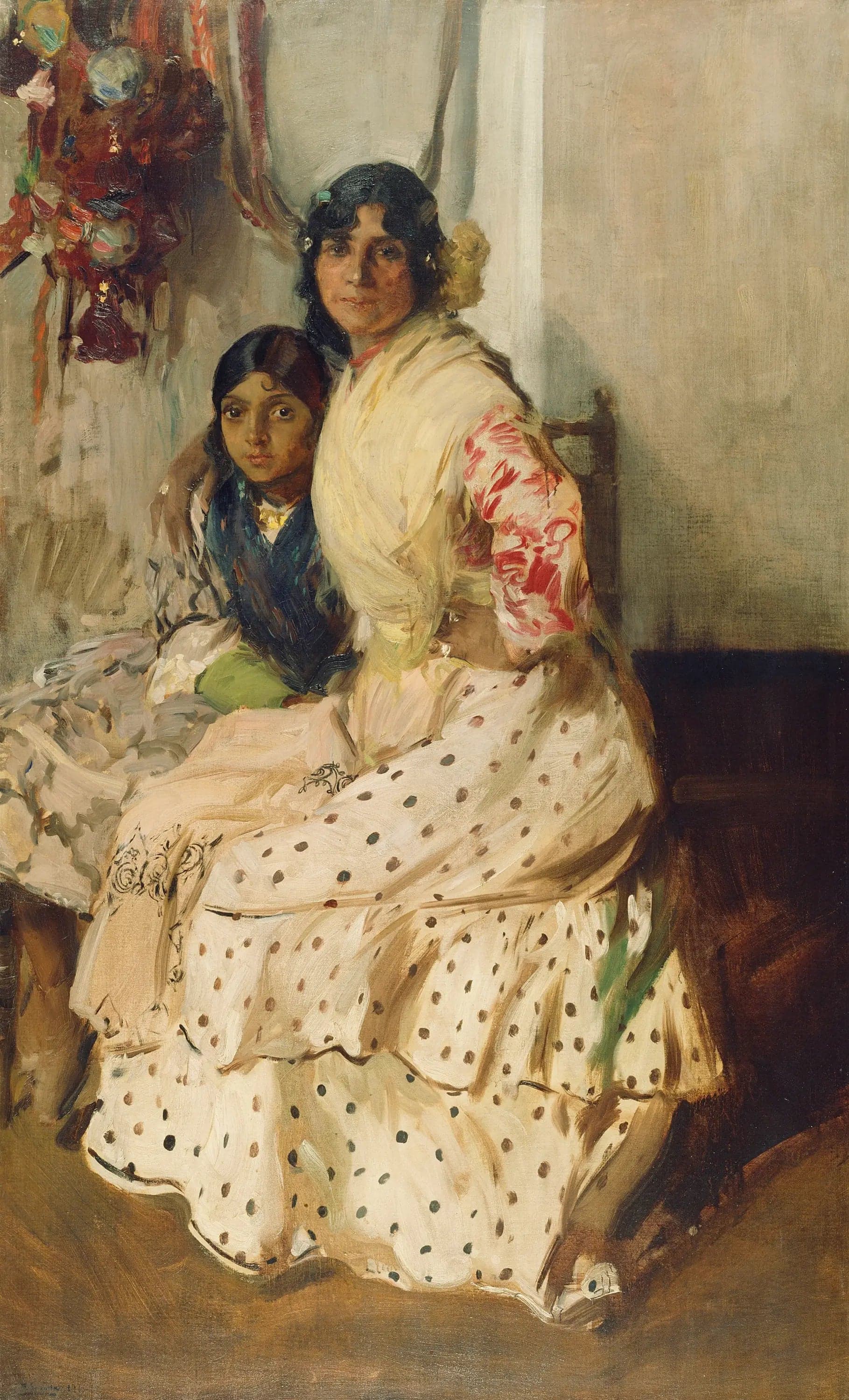
Pepilla the Gypsy and Her Daughter
- Original dimensions
- 43.5 x 71.5 cm
- Museum
- J. Paul Getty Museum
- Year
- 1910
Scene depicted
In this masterpiece, Sorolla immortalizes a moment of intimacy between a gypsy mother and her daughter. The composition , bathed in golden light, reveals the tenderness and deeply human connection that exists between them. Their knowing and serene gaze reflects the culture, tradition, and spirituality that inhabit their daily lives, offering the viewer a window into a reality often unknown.
Historical context
Created in 1910, this painting emanates from the brilliant mind of Joaquín Sorolla , a master of the Spanish Impressionist movement. Made at a time when Spain was experiencing a cultural effervescence, this canvas captures beauty in a Mediterranean setting. The painting , exhibited at the J. Paul Getty Museum in Los Angeles, testifies to a unique technical mastery and great emotional depth.
Place in the artist's career
“Pepilla la gitane et sa fille” occurs at a crucial point in Sorolla's career. After years of refinement, this painting represents a stylistic peak, where technique and emotion intertwine. In parallel with works such as “La plage de Valencia” and “Les bouquetières,” this painting illustrates the artist's technical evolution, moving from simple representation to an overflowing emotional immersion.
Anecdote
“I have always sought to capture light and life in my paintings . It is in the gazes of people that one finds the essence of painting,” Sorolla is said to have remarked one spring morning on the sunny shores of Valencia. This intimate and personal vision of art resonates in the evocative power of the painting “Pepilla la gitane et sa fille,” where each brushstroke tells a vibrant story.