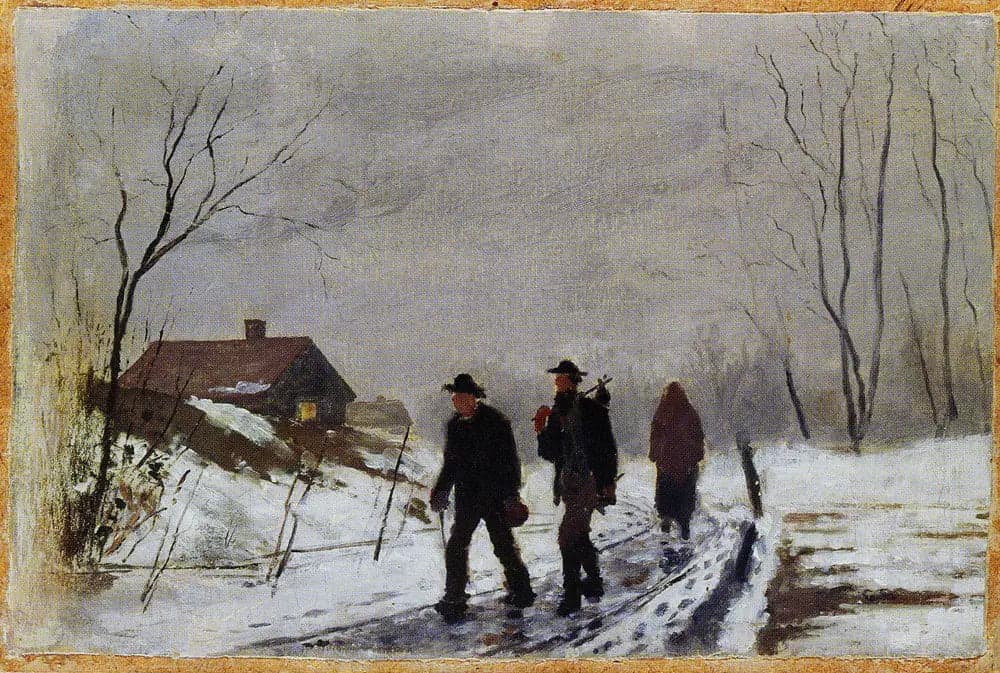
People on the Red in a Wet Snow
- Original dimensions
- 19.5 x 13 cm
- Museum
- Not specified
- Year
- 1881
Scene depicted
The canvas "People on the Red in a Wet Snow" shows a group of people walking on a surface marked by a vibrant red hue contrasting with the wintry environment. This painting illustrates a striking dichotomy, where the warmth of a bright color confronts the coldness of the snow, evoking both isolation and human connection. Each silhouette, frozen in delicate movement, seems to narrate a story, a fleeting moment of human interaction in a chilly ambiance.
Historical context
Created in 1881, the painting "People on the Red in a Wet Snow" by Edvard Munch finds its artistic roots in the vibrant city of Oslo, Norway. This work is emblematic of the expressionist movement, which emerged in reaction to the academic and realistic norms of the time. Painted during a period when personal emotions and inner feelings took center stage in art, the canvas bears witness to a deep introspection within a society in full transformation. Although the current destination of this work remains uncertain, its precise and delicate dimensions echo the finesse of an artist undergoing an inner revolution.
Place in the artist's career
This painting is an important milestone in the career of Edvard Munch , placing his work at the intersection of personal discovery and collective expression. It fits into a period when the artist begins to assert himself, following works such as "The Scream" and "Madonna," foreshadowing the emotional mastery that will characterize his later creations. The tension between light and darkness, present here, will become characteristic of his painting style throughout his career.
Anecdote
"When I paint, I do not just try to reproduce reality, I seek to capture its essence," Munch might have said while contemplating his creation. Imagine a winter morning, the snow appears fluffy and heavy due to the frost. Around a street corner, silhouettes emerge, their indistinct shapes blending with the humid atmosphere. It is this fleeting and emotion-laden moment that inspired the painting , filling the canvas with a vibrant energy, a palpable melancholy.