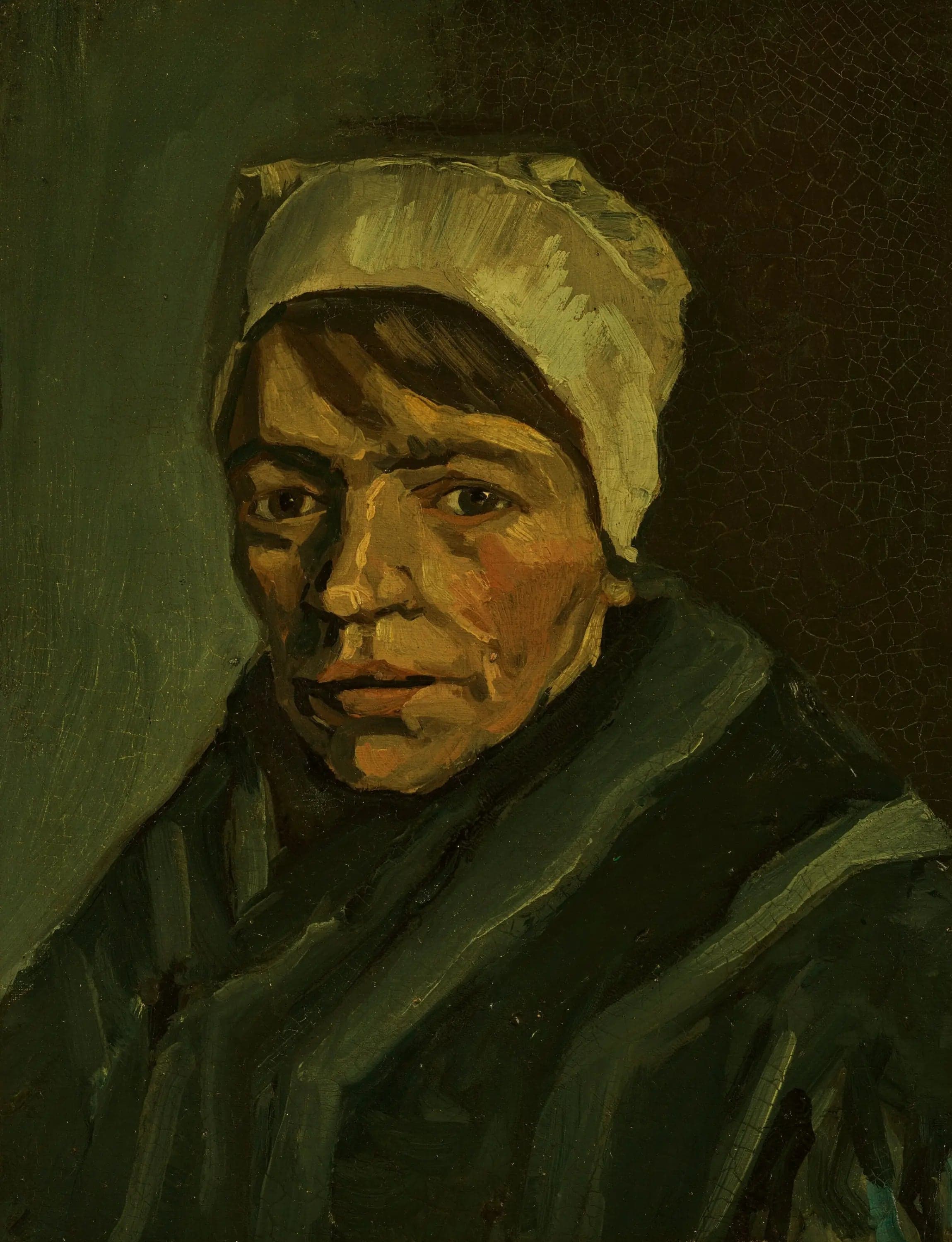
Peasant Woman's Head with White Bonnet
- Original dimensions
- 30 x 38 cm
- Movement
- realism
- Museum
- Not specified
- Year
- 1885
Scene depicted
In this canvas , Van Gogh narrates the face of a laborious life, tenderly exposing the features of a peasant woman, this archetype of the inhabitants of the Dutch countryside in the 19th century. The delicate lines and subtle shades of the painting allow us to access a silent voice, that of the workers and their daily lives. The composition is both simple and powerful, engaging us in introspection about the value of work and the beauty of rural life.
Historical context
Created in 1885, in Nuenen , this painting is part of the realistic movement, emerging from the social and human concerns of the time. Vincent van Gogh , still in the process of becoming and fully exploring his artistic path, delivers here a precious scene that speaks of rural life. This canvas , a sincere reflection of simplicity and dignity, is not preserved in a known museum but remains an emblematic piece in the history of art.
Place in the artist's career
Peasant Head with White Bonnet represents an important milestone in the career of Vincent van Gogh , a promising beginning where he bursts with creativity. This canvas marks the transition between his early works of the 1880s and his later post-impressionist explorations. To be associated with his canvas The Potato Eaters , a predominant work on peasant life, and Starry Night , which conveys his vibrant and dreamlike approach to painting .
Anecdote
“I encountered a face marked by hard labor, that of a peasant woman with a white bonnet. In her simplicity, I found a deep beauty.” This quote, inspired by Van Gogh's spirit, evokes the moment he saw this woman, one spring morning, the soft sunlight enhancing her working face. This fleeting emotion transforms into the evocative power of his masterpiece .