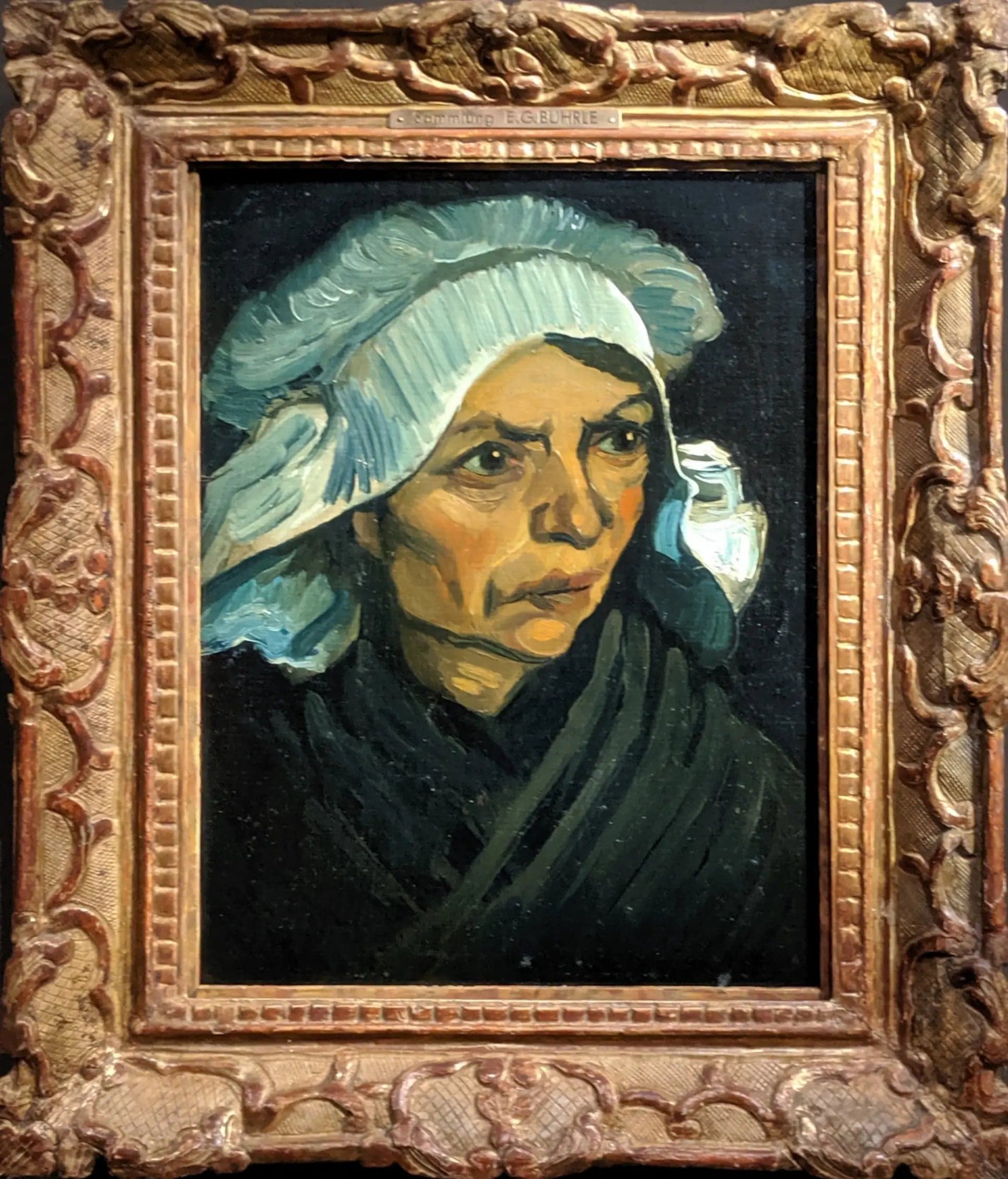
Peasant Woman's Head with White Bonnet
Scene depicted
The painting “Tête de paysanne au bonnet blanc” evokes a poignant vision of a rural woman, her features marked by labor and resilience. The white bonnet, a symbol of her status, delicately contrasts with the dark background, accentuating the serene expression of her gaze. This pictorial work immerses us in the deep and authentic humanity of its subject, offering a reflection of peasant life in the 19th century.
Historical context
Created in 1885 in the city of Nuenen , this painting is emblematic of the post-impressionist movement. At that time, Vincent van Gogh explored rural themes, revealing the beauty of landscapes and the faces of peasantry. The work is currently preserved at the Emil G. Bührle Foundation and Collection , where its presence captivates visitors. Its dimensions, 31.5 x 41 cm, testify to an intimate and delicate composition.
Place in the artist's career
At this point in his career, this painting represents a turning point for Vincent van Gogh . It is part of his formative years, marked by a quest to represent the laboring souls. Compared to works like “ The Potato Eaters ” or “ The Siesta ”, this composition demonstrates a growing mastery of color and form, while maintaining that unique sensitivity.
Anecdote
Van Gogh said: “I wanted to paint faces and beings that reflect the silent dignity of workers.” It was on a gentle spring morning, while he was walking the streets of Nuenen , that he crossed the gaze of a peasant woman whose white bonnet illuminated his creative spirit. This fleeting encounter infused emotional strength into the canvas , bringing this masterpiece to life.