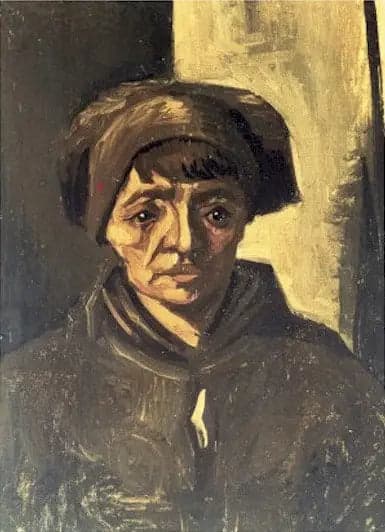
Peasant Woman's Head with Black Bonnet
Scene depicted
In this canvas , Van Gogh carefully depicts the face of a peasant woman, her gaze immersed in a secret garden of emotions. Her black bonnet, a symbol of simplicity and strength, frames an expression that tells stories of resistance and resilience. Each brushstroke evokes the texture of rural life, vibrating with shades of the everyday.
Historical context
Created in 1885, the painting "Peasant Head with Black Bonnet" is the work of a burgeoning Vincent van Gogh , then located in Nuenen , Netherlands. A member of the artistic movement of realism , this canvas reflects a time when Van Gogh explored the peasant condition with unparalleled emotional intensity. Currently, the painting is not associated with a known museum, but its dimensions, 31.7 x 40.6 cm, make it a modest-sized masterpiece capable of unleashing immense power in the space it occupies.
Place in the artist's career
"Peasant Head with Black Bonnet" positions itself early in Van Gogh's career, marking a turning point towards a deeper sensitivity. Alongside famous paintings like " The Potato Eaters " and " The Sower ", this pictorial work reveals the evolution of his technique and his perspective on human suffering, seeking to highlight the intrinsic beauty of modest existence.
Anecdote
"Beauty lies in the simplicity of hardworking souls." Vincent van Gogh may have captured this thought as he observed a peasant woman in the silence of a misty morning, inspired by the striking faces and hard labor of the people of the land. In this intimate moment, the painting comes to life, carrying a profound humanity.