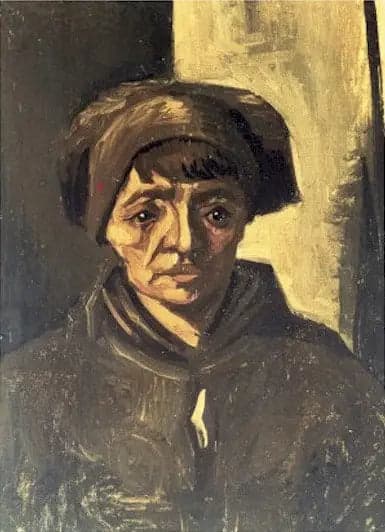
Peasant Woman's Head with Black Bonnet
Scene depicted
In this painting, Vincent van Gogh depicts a peasant woman, embodying the dignity and depth of rural existence. Her gaze is both thoughtful and sharp, revealing a life marked by labor and resilience. This masterpiece is a tribute to those who build daily life with courage and perseverance. The simplicity of the motif is enhanced by the finesse of the details, inviting the viewer to contemplate the beauty of laborious life.
Historical context
This painting was created in 1885, in the charming municipality of Nuenen , in the Netherlands, and is part of the artistic movement of realism . At that time, Vincent van Gogh was fully engaged in exploring themes related to rural life, focusing on iconic figures of everyday life. The original painting , whose precise location is not documented, measures 19 x 25 cm.
Place in the artist's career
Peasant Head with Black Bonnet lies between Van Gogh's promising beginnings and his period of emotional maturity. It is a revealing work, comparable to the painting The Potato Eaters and the Self-Portrait with Hat . These paintings show the artist's stylistic evolution, with an increasing filling of emotion and a dramatization of textures.
Anecdote
“I aspire to capture the soul of people through my canvases ,” Van Gogh might have said while creating this work. Imagine him one spring morning, walking through the streets of Nuenen , crossing the gaze of a peasant woman with a black bonnet, a symbol of simplicity and strength. This fleeting moment infused the painting with so many emotions.