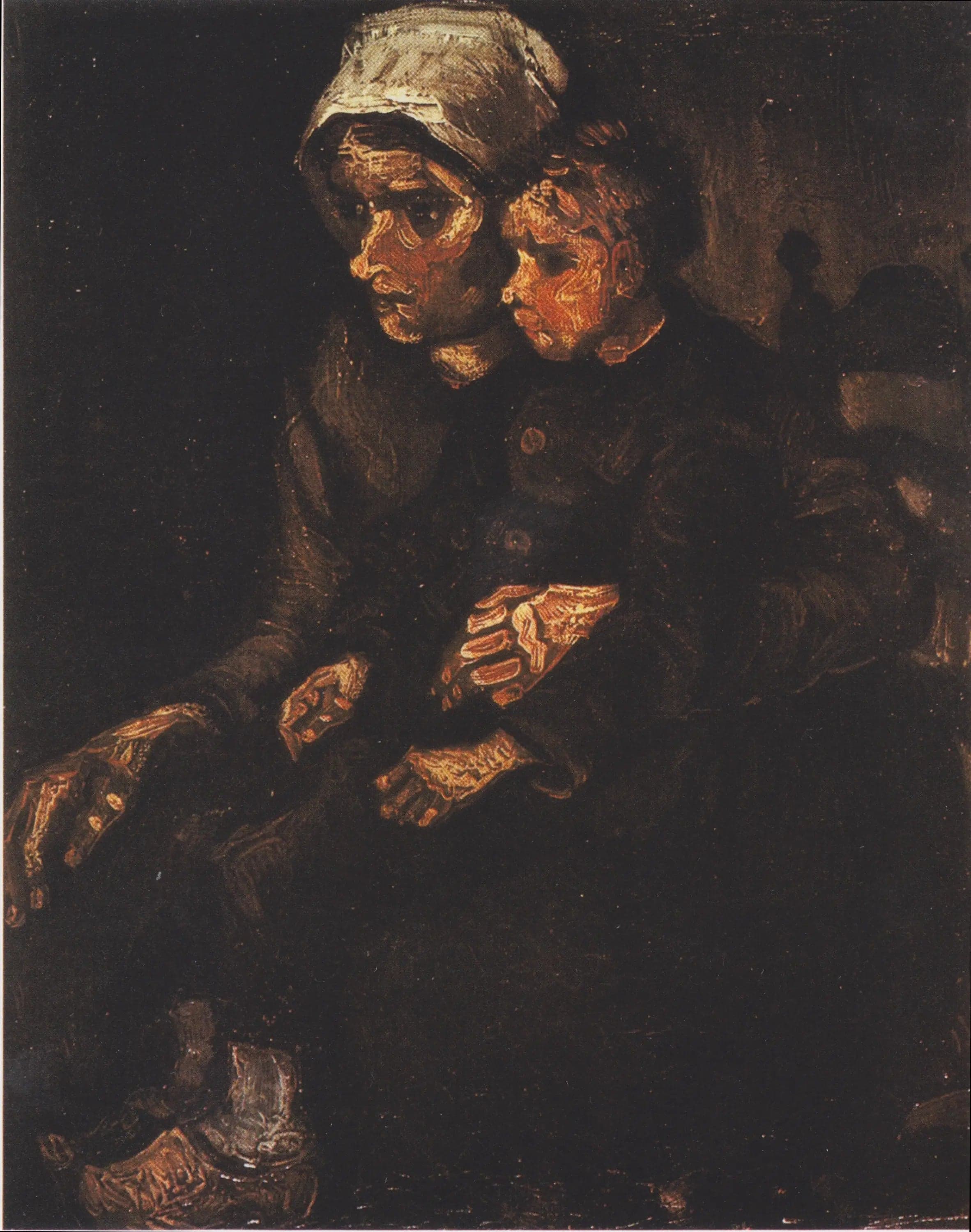
Peasant Woman with a Child on Her Lap
Scene depicted
This painting offers an intimate portrayal of rural life, where a peasant woman, her arms enveloping her child, seems to summarize the entire silent melody of the simple joys of motherhood. The expressions on their faces, the tenderness of the gesture, immerse the viewer in a warm and comforting atmosphere, full of the humanity characteristic of Van Gogh's work.
Historical context
Created in 1885, this painting emblematic was born in Nuenen , in the heart of the Netherlands, during a time marked by post-impressionism . The artistic movement of the 19th century reflects a fundamental change in the perception of art where light and color dominate the compositions. Currently, the canvas is not specified in a known collection, but its stature as a work of art remains indisputable, with dimensions of 34 x 43 cm.
Place in the artist's career
“Peasant Woman with Child on Her Lap” is positioned at a key moment in Van Gogh's career, where he seeks to represent his favorite themes: nature, simplicity, and daily life. At this time, two other canvases mark his trajectory: “ The Potato Eaters ” and “ The Starry Night ”, each reflecting his stylistic and emotional evolution through a palette of vibrant colors and a deep expression of humanity.
Anecdote
Vincent van Gogh once said: “When I paint, I release my emotions, and each brushstroke tells a story.” It was in the calm of a spring morning, surrounded by the soft sounds of awakened nature, that this pictorial work came to life, capturing the tenderness of a mother and her child, resonating with an unmatched evocative power.