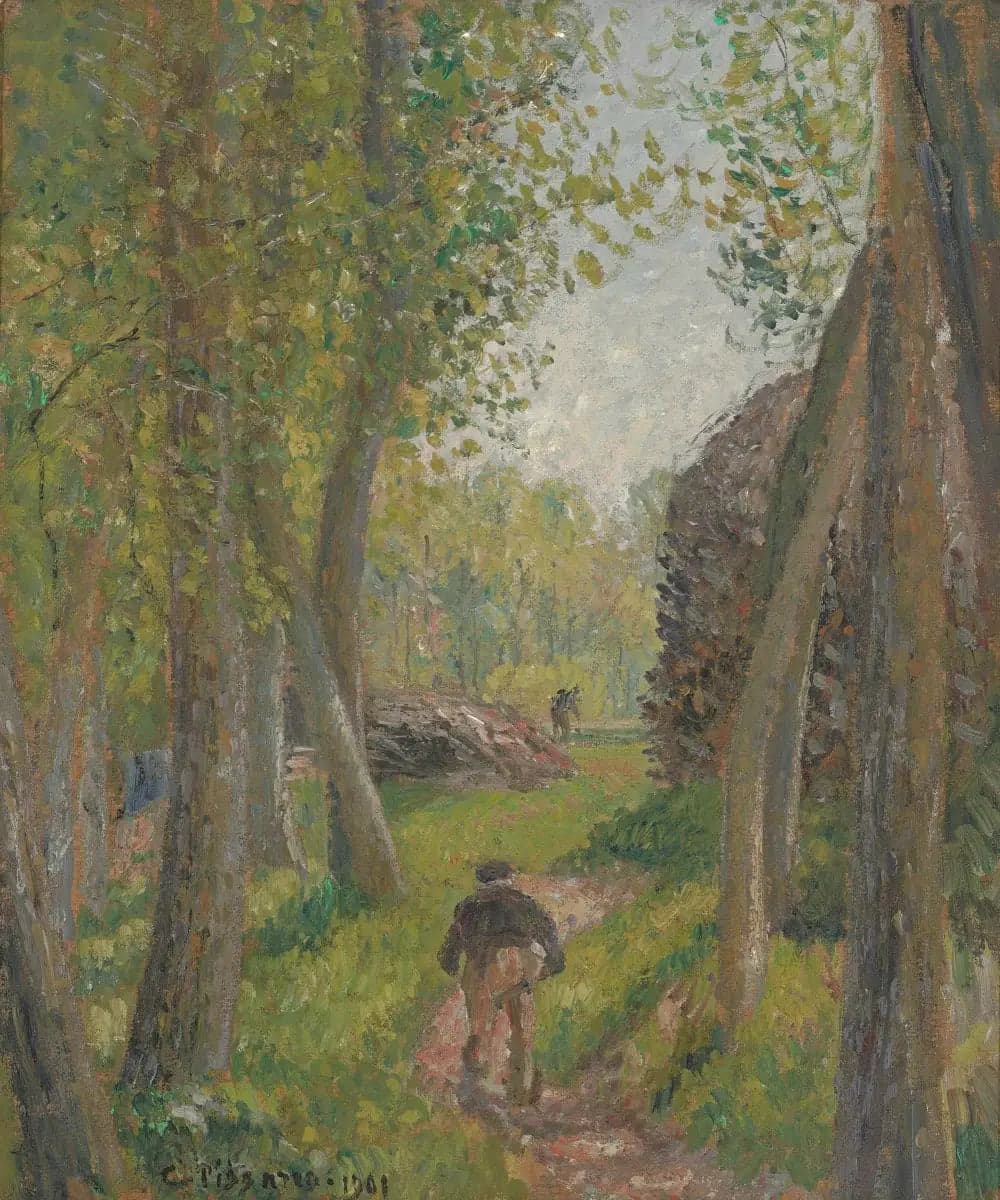
Peasant Seen from Behind in a Underwood, Moret
- Original dimensions
- 69.9 x 78.7 cm
- Museum
- High Museum of Art
- Year
- 1901
Scene depicted
The painting “Peasant Seen from Behind in a Underwood, Moret” is an invitation to contemplate the modesty of everyday life. The silhouette of a peasant, turned towards nature, seems absorbed by the soft shadows of the trees. Pissarro skillfully combines light and texture to create an atmosphere that breathes peace and reflection, where time passes slowly, almost imperceptibly.
Historical context
This painting emblematic, created in 1901, is set in the bucolic setting of Moret-sur-Loing, a picturesque commune located in Seine-et-Marne. Camille Pissarro , a pillar of impressionism , captures here the serenity of a peasant evolving in a underwood, symbol of an era where nature and man coexisted harmoniously. Currently, this canvas is preserved at the High Museum of Art , where it fascinates visitors with its evocative dimension.
Place in the artist's career
This painting is an important milestone in Pissarro's career, representing a moment of artistic maturity. Compared to his earlier works such as “The Garden of the Infanta” and “The Harvest of Potatoes”, it reflects an evolution towards more intimate and pastoral scenes, where human emotion perfectly blends with the landscape.
Anecdote
“Nature is my only mistress.” These words resonate throughout Pissarro's work, who was inspired by a spring morning while wandering in the underwoods. It is there, cradled by the song of birds and the fresh scent of wet grass, that he realized this masterpiece , immortalizing the simplicity and beauty of a fleeting moment.