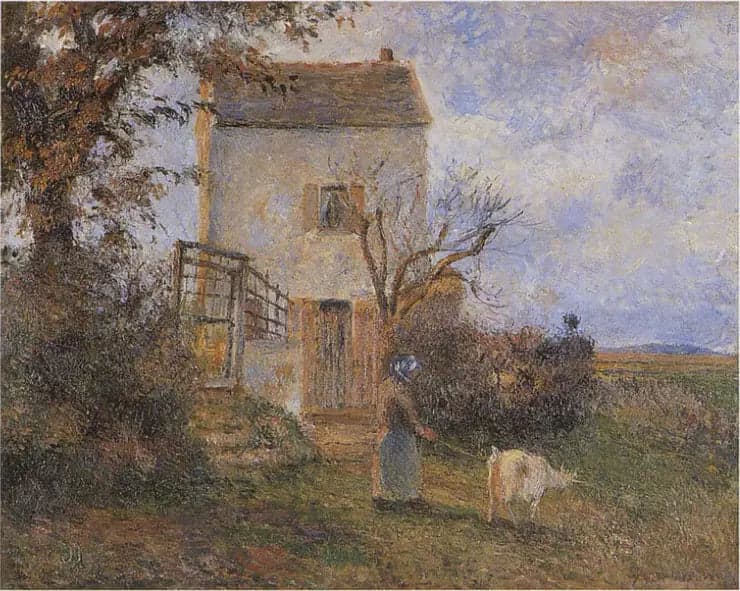
Peasant and goat in front of a house, surroundings of Pontoise
- Original dimensions
- 70 x 58 cm
- Museum
- Muskegon Art Museum
- Year
- 1879
Scene depicted
This painting evokes a bucolic scene where a peasant woman, in harmony with nature, takes care of her goat in front of a country house. The vibrant composition denotes the serenity of rural spaces, while highlighting the intimate bond that unites the characters with the surrounding landscapes. Every detail, from the peasant woman's smile to the softness of the forms, reveals Pissarro's love for his subject, inviting deep contemplation.
Historical context
Created in 1879, this painting , emblematic of the Impressionist movement, finds its roots in the peaceful landscapes of the surroundings of Pontoise, France. At that time, Pissarro, one of the great masters of Impressionism , explores the simple beauty of rural life and the harmonious interactions between man and nature. Today, this magnificent canvas is preserved at the Muskegon Art Museum, where it continues to captivate visitors with its timeless charm.
Place in the artist's career
“Peasant and Goat in Front of a House, Surroundings of Pontoise” is part of a pivotal period in Pissarro's career, where he deepens his Impressionist language. This painting reflects the evolution of his style, parallel to his other works such as “The Potato Harvest” and “Boulevard Montmartre, Spring,” where the tones and perspectives become bolder, revealing his commitment to an ever more vibrant pictorial expression.
Anecdote
“Beauty lies in the everyday. Every moment deserves to be immortalized.” It is through this quest for authenticity that Pissarro found inspiration for his painting . One sunny morning, he strolls through the fields, a sweet scent of flowers fills the air. It is in this tranquil atmosphere that he spots a peasant woman and her goat, a moment that seems perfect for capturing the very essence of rural life.