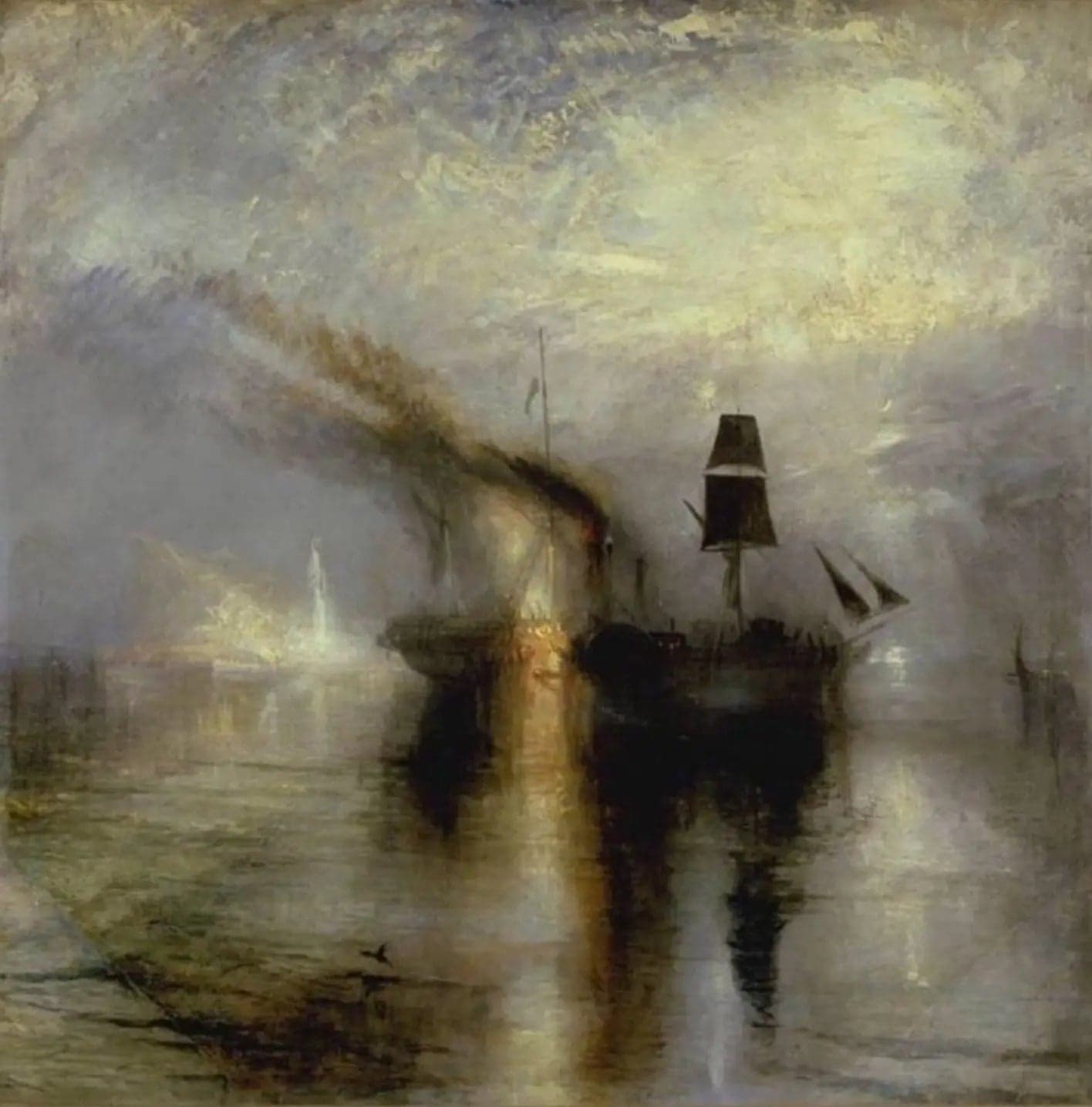
Peace - Sea Burial
- Original dimensions
- 86.7 x 87 cm
- Museum
- Tate Britain
- Year
- 1842
Scene depicted
The canvas illustrates a funeral ceremony at sea. A body, adorned with flowers, drifts towards the horizon while white sails rise against a changing sky. Turner, true to his style, uses light and subtle colors to evoke a deep sense of serenity amidst the drama.
Historical context
Created in 1842, this painting is emblematic of a United Kingdom undergoing industrial transformation. Joseph Mallord William Turner , a prominent figure of romanticism , uses his artistic genius to capture intense emotions on canvas. Currently displayed at the Tate Britain in London, this canvas testifies to the mastery of an artist whose works captivate with their depth and light.
Place in the artist's career
This work is at the heart of Turner’s maturation, demonstrating a shift towards a more abstract style. Compared to his earlier canvases like "The Fighting Temeraire" and "Rain, Steam and Speed," this painting represents a turning point towards compositions where emotion prevails over precision of detail.
Anecdote
In his words, Turner often spoke of the divide between the sea and the sky: “Nature reveals itself, and I observe it. I translate the inexpressible.” Inspired by the tumult of the waves, on a misty morning, he gave birth to a masterpiece that speaks of peace, memory, and the ephemeral beauty of life.