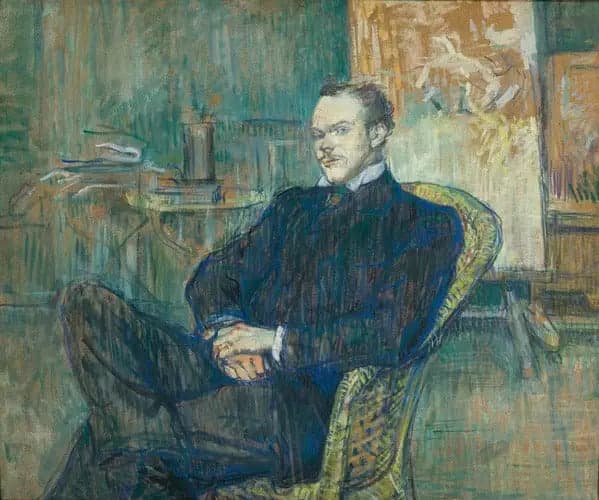
Paul Leclercq - Henri de Toulouse
- Original dimensions
- 67 x 54 cm
- Museum
- musée d'Orsay
- Year
- 1897
Scene depicted
In this vibrant canvas , Toulouse-Lautrec captures the very essence of the famous character of Paul Leclercq, immersing the viewer in the world of the Parisian artistic scene. One can feel the warmth of lively discussions, the sweet scent of fresh paint, and the memory of the flickering lights of the cafés. Every detail, every brushstroke, tells a story of passion and creation.
Historical context
Created in 1897, during the flourishing era of Montmartre in Paris, this painting is part of the post-impressionism movement. The canvas is now located in the famous musée d'Orsay, a key place for preserving French artistic heritage, and measures 67 x 54 cm, a size that invites introspection.
Place in the artist's career
This canvas marks a crucial turning point in Toulouse-Lautrec's career. Following his early iconic works, such as “Le Moulin Rouge” and “La Toilette,” “Paul Leclercq” demonstrates a growing mastery of form and color, marking a significant evolution in his artistic journey.
Anecdote
Henri de Toulouse-Lautrec once passionately expressed: “Art is the gaze we cast on the little things in life.” This led him to immortalize the vibrant atmosphere of Parisian cabarets. The painting “Paul Leclercq” was born one summer morning, where the golden light played with the silhouettes of the artists, infusing a new life into his masterpiece .