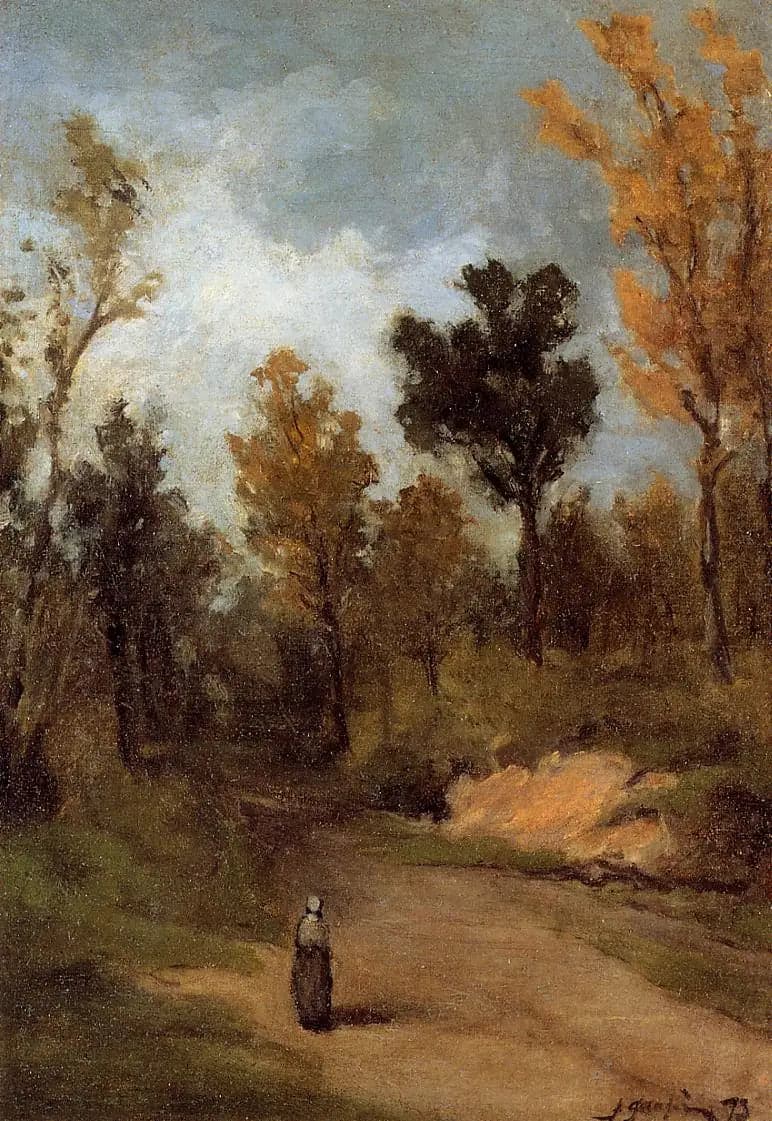
Path in the Forest
- Original dimensions
- 30.5 x 43.2 cm
- Museum
- Not specified
- Year
- 1873
Scene depicted
The painting “Path in the Forest” illustrates a winding bucolic path, lined with majestic trees, bathed in a soft filtering light. Through this pictorial work , Gauguin captures the very essence of nature, the depth of the woods. It is a passage between two worlds, that of the everyday and that of daydreaming, where each step on the path becomes an invitation to escape.
Historical context
Created in 1873, the painting Path in the Forest by Paul Gauguin emerges from a rich artistic context, situated in the streets and forests of Paris, during the time of impressionism . This painting is considered a precursor to his fiery style that would later flourish in his career. Today, the work lives outside of major museums, and is illustrated in private collections, thus testifying to its uniqueness and fascinating history.
Place in the artist's career
Positioned at the beginning of Paul Gauguin 's career, Path in the Forest testifies to a period of experimentation. In parallel with other paintings from this time such as “The Vision After the Sermon” and “The Scarecrows”, this canvas marks the birth of a bold and personal style that will define him durably among post-impressionists .
Anecdote
“Nature is a call that we must learn to listen to. Every leaf, every path, tells a story.” This phrase suggests the moment when Gauguin, wandering in the forest one spring morning, found inspiration for this masterpiece . The vibrant colors and composition evoke beauty frozen in time, as if every sound of nature mingled with the painting .