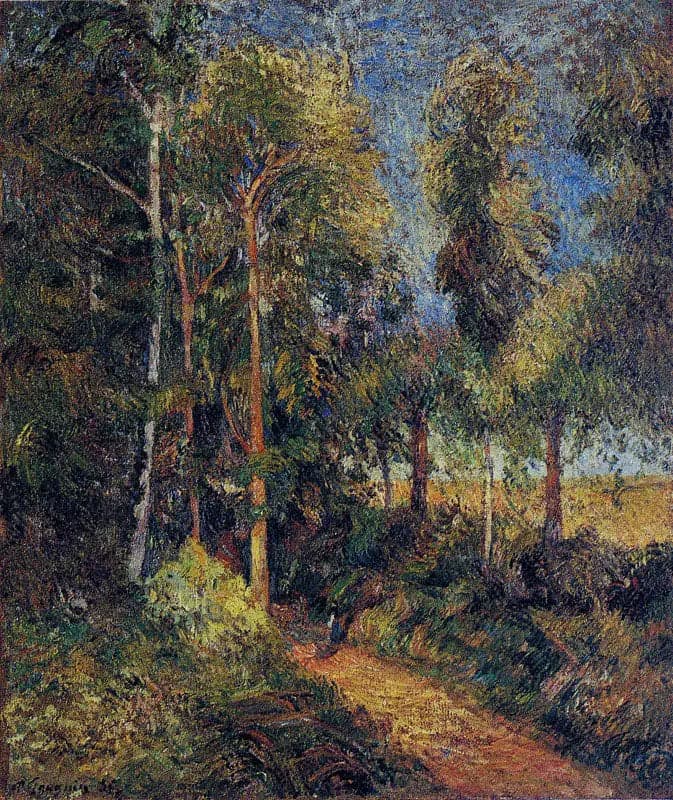
Path in the Beech Grove
- Original dimensions
- 46 x 55 cm
- Museum
- Aargau Art Museum
- Year
- 1885
Scene depicted
In this painting , a delicate light weaves between the majestic trees of a beech grove, illuminating a tranquil path. The soft ground, strewn with leaves, appears inviting, like a call to contemplation. The atmosphere invites a dreamy stroll, awakens the senses, and transports the mind to a perfect harmony between man and nature.
Historical context
Created in 1885, Path in the Beech Grove is an unexpected testimony of the post-impressionist movement, where Paul Gauguin weaves connections between color and emotion. This pictorial work comes to life in the peaceful town of Aargau, Switzerland, a setting conducive to artistic inspiration. Today, this painting rests in the Aargau Art Museum, showcasing its grandeur and beauty.
Place in the artist's career
Path in the Beech Grove represents a crucial step in Gauguin's career, symbolizing his transition to bolder and more emotional compositions, after pieces such as The Vision of the Last Night and The Yellow Christ . This painting illustrates his ability to capture the intrinsic beauty of nature while asserting his own bold and striking style.
Anecdote
“A path is needed to discover beauty.” These words from Gauguin evoke the precious moment when the artist, wandering in the heart of a soothing forest, encountered a gentle ray of sunlight filtering through the branches. Inspiration flows, and gradually, this masterpiece of wooded peaks takes shape, enveloping the viewer in a warm embrace.