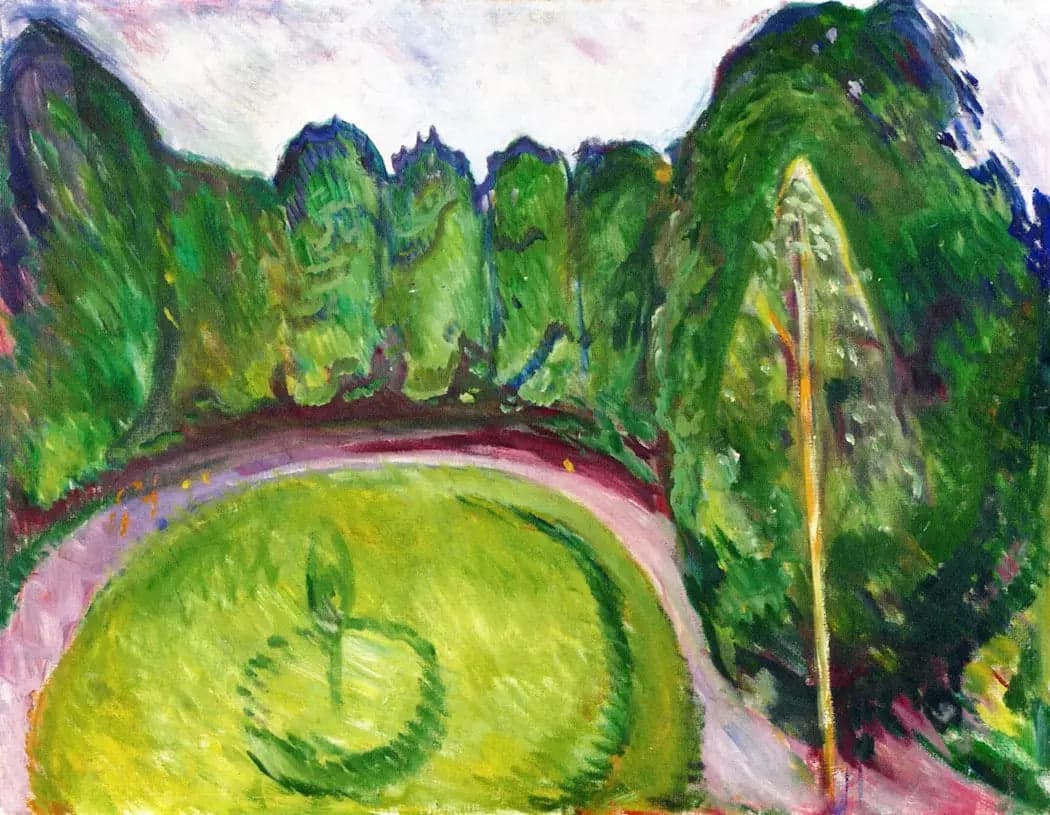
Park
- Original dimensions
- 110 x 83.5 cm
- Museum
- Munch Museum
- Year
- 1906
Scene depicted
In "Parc," Edvard Munch succeeds in capturing a scene of urban life, surrounded by melancholy. We see solitary figures, lost in their thoughts, walking through this peaceful haven. The majestic trees, witnesses to these moments, seem to vibrate with human emotions, infusing the painting with both an intimate and universal dimension.
Historical context
Created in Oslo, Norway, in 1906, the painting "Parc" is part of the expressionist movement. In a time of artistic upheaval, the pictorial scene of this era is nourished by social and psychological tensions. Currently exhibited at the Munch Museum, this canvas of 110 x 83.5 cm captures a moment frozen in time, at the crossroads between shadow and light.
Place in the artist's career
This canvas marks a pivotal moment in Munch's career, revealing his evolution from symbolic imagination to a more raw expressionism . Around this canvas , works such as "The Woman in Green" and "The Scream" highlight the expansion of his dark and psychological themes, where human emotion dominates.
Anecdote
"Nature is not just a setting, but an emotional partner," Munch might have said when talking about the genesis of his masterpiece . Inspired by a spring morning, he found in this canvas the echo of a resurfacing memory: the laughter of children and the sweet scent of wet earth, merging with the tranquility of a still-sleeping park.