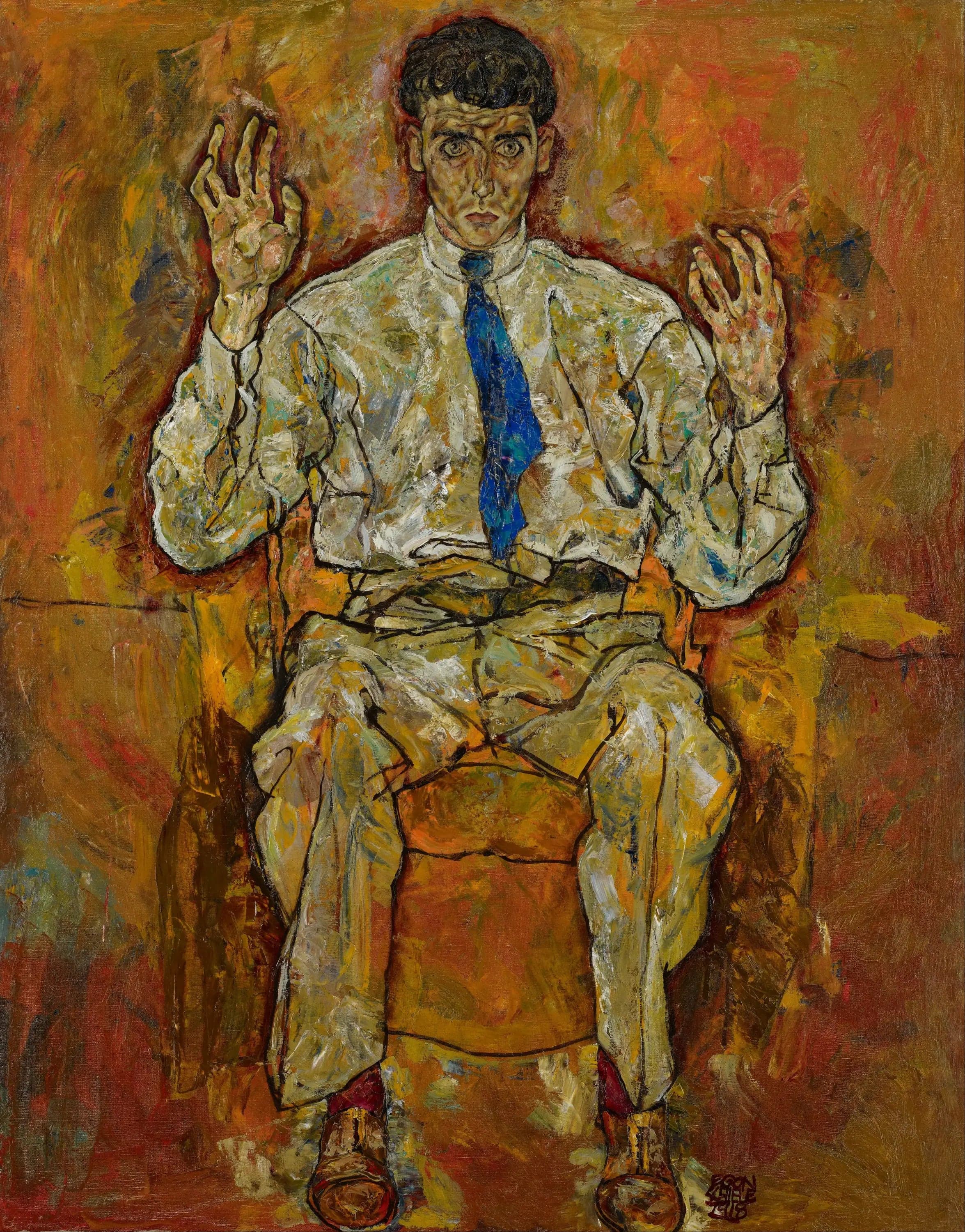
Paris of Gütersloh
- Original dimensions
- 43.4 x 55.1 cm
- Museum
- Minneapolis Institute of Art
- Year
- 1918
Scene depicted
The scene depicted in Paris de Gütersloh is imbued with mystery. Architectural figures emerge under the intense gaze of an artist in search of identity. The dynamism of lines and shapes, combined with a rich palette, conveys an atmosphere of anxiety and exuberance, typical of Egon Schiele 's unique vision. This painting is as much a personal exploration as it is a reflection on the society of its time.
Historical context
Created in post-war Austria in 1918, the painting Paris de Gütersloh is part of the expressionist movement, an artistic current in full swing. Its current location, within the Minneapolis Institute of Art , attests to its invaluable worth. This masterpiece , measuring 43.4 x 55.1 cm, reflects a pivotal time when creativity broke free from past conventions.
Place in the artist's career
This painting is situated in a key period of Egon Schiele 's career, marking both technical and emotional maturity. At the crossroads of anxiety and passion, it recalls works like “Self-Portrait” and “The Dance of Death,” demonstrating a constant evolution towards a more bubbling expressiveness and an increased mastery of emotions.
Anecdote
“Every brushstroke is a cry from the heart,” said Schiele. It was on a misty morning in Vienna, as a soft light filtered through the cobbled streets, that he found inspiration for this poignant painting . A face, a silhouette, a light: everything blends in this artwork , evoking deep emotion, a fleeting encounter made eternal.