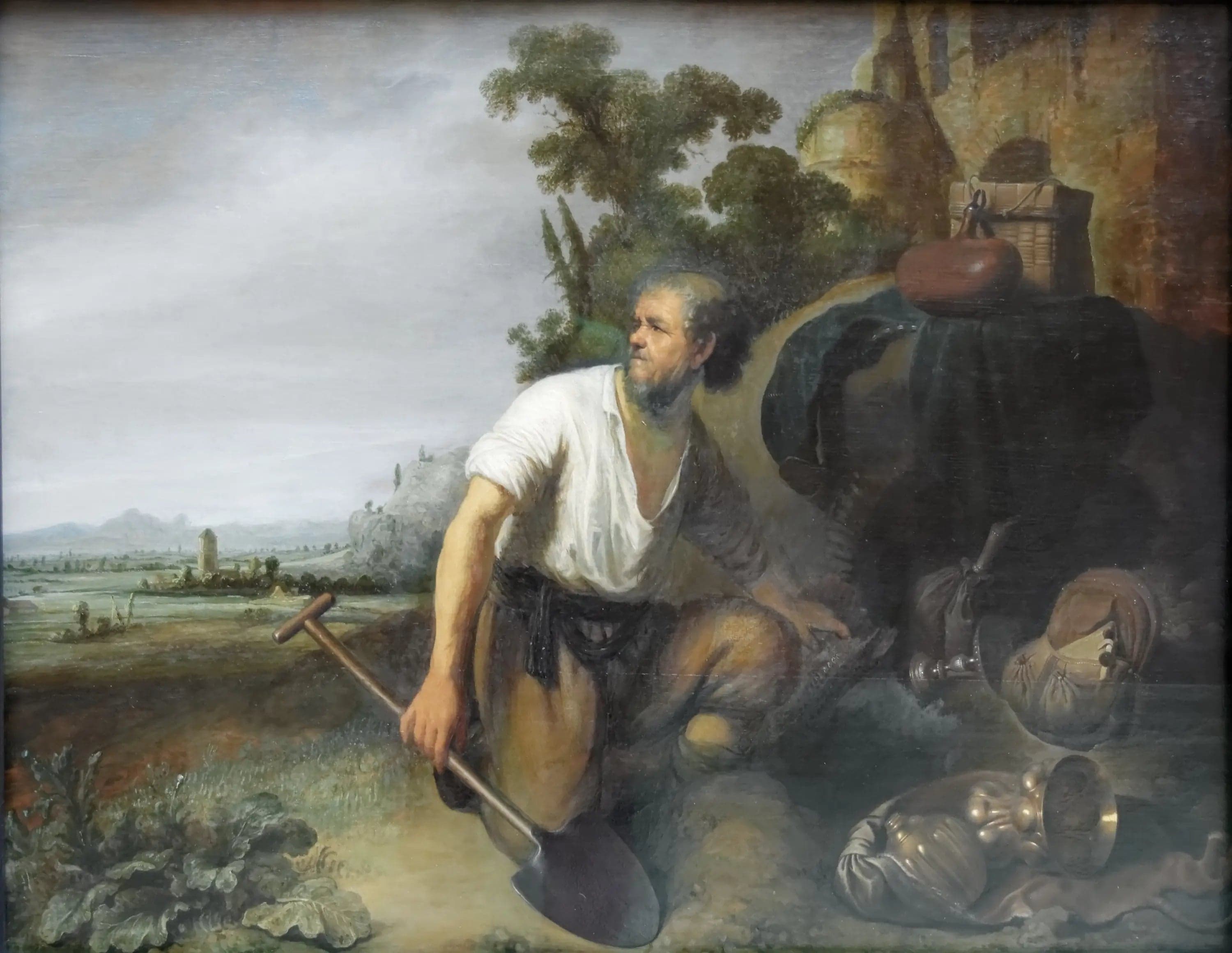
Parable of the Hidden Treasure
- Original dimensions
- 90 x 70.5 cm
- Museum
- Museum of Fine Arts of Budapest
- Year
- 1630
Scene depicted
The composition of "Parable of the Hidden Treasure" illustrates a profound biblical teaching. The scene highlights redemption and acceptance, with a central character who, in an evocative gesture, expresses his repentance before his father. This painting demonstrates how Rembrandt manages to capture feelings of compassion and love, transforming these moments into true visual stories.
Historical context
Work : Parable of the Hidden Treasure |BRK| Artist : Rembrandt |BRK| Year : 1630 |BRK| Museum : Museum of Fine Arts of Budapest |BRK| Dimensions : 90 x 70.5 cm |BRK|
Place in the artist's career
"Parable of the Hidden Treasure" marks a turning point in Rembrandt 's career, indicating a moment of stylistic and emotional maturity. Compared to other works like "The Night Watch" and "The Maids of Honor," this painting reveals a deepening of his psychological approach and an even more refined use of light, demonstrating a unique evolution of his art.
Anecdote
"The art of painting is not just a matter of form, it is the light of the soul that we fix on the canvas." Rembrandt might have said this on a bright morning, while contemplating life around him, marked by the face of a beggar encountered in a sunlit alley. This painting , like his inspiration, reflects this poignant light, capturing a moment of spirituality that transcends time.