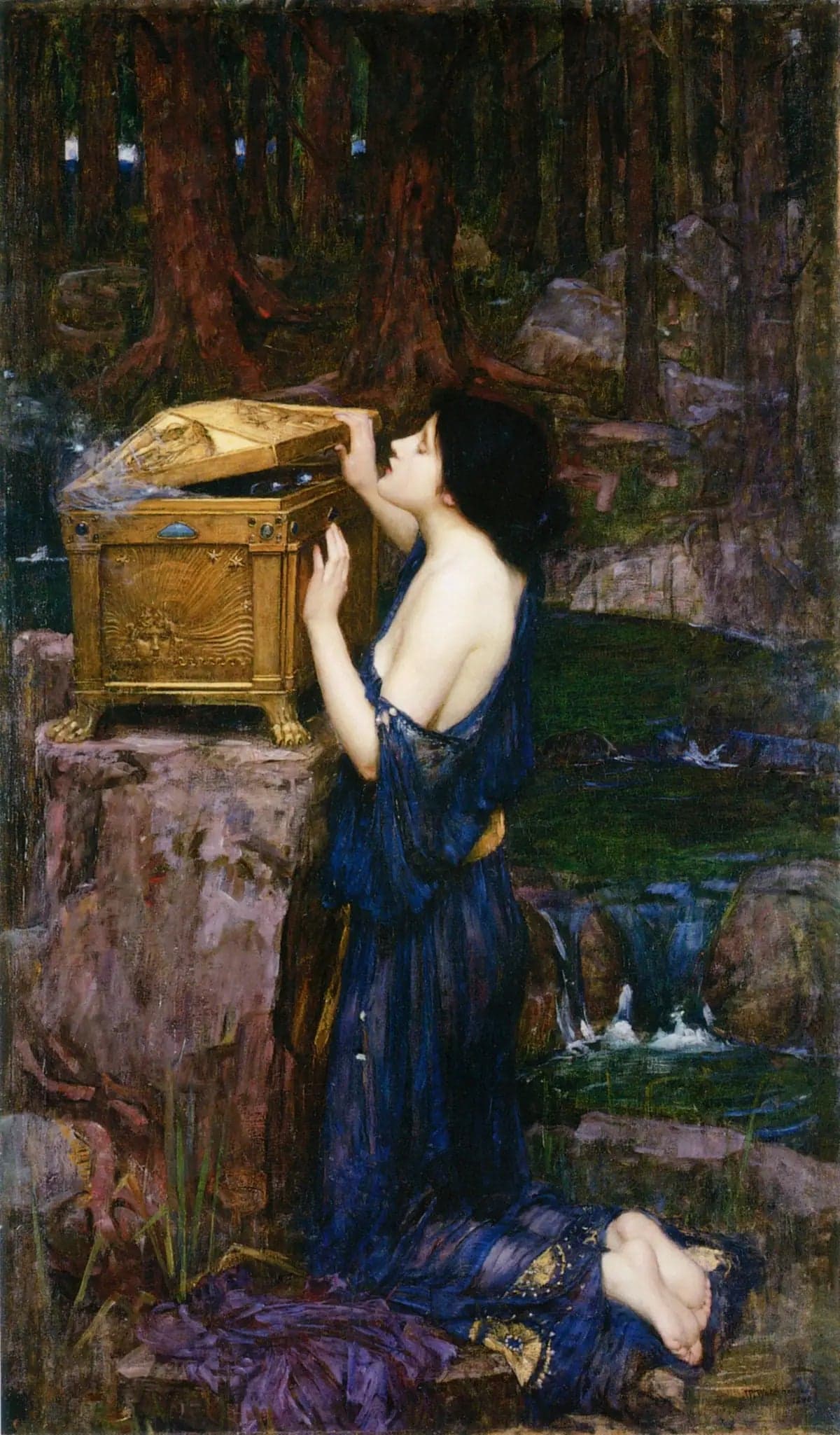
Pandora
Scene depicted
In this painting , Pandora, the first woman of Greek mythology, stands alone in front of a mysterious box, a symbol of curiosity and fate. Derived from the myth of Epimetheus, this canvas highlights the struggle between innocence and temptation, capturing a moment of contemplation and dramatic tension woven into its vibrant colors.
Historical context
Created in 1896, this painting is emblematic of the Pre-Raphaelite artistic movement. Made in London, this canvas explores myths and classical beauty. Currently, the painting is housed at the Tate Britain , a recognized museum, reflecting the influence of the Victorian era that celebrated aesthetics and imagination. Its dimensions are 92 x 121 cm.
Place in the artist's career
Considered a pinnacle of his career, Pandora testifies to Waterhouse's evolution, alongside other masterpieces like The Nymph at the Source and Ulysses and the Sirens . All three share a radiant light and fine composition, demonstrating his ability to weave a rich and emotional story through his paintings .
Anecdote
“Inspiration can arise at every corner, in the shade of a tree or in the gentle murmur of a river,” said Waterhouse. It was in the turn of a spring brushed by the breeze, in a garden scented with blooming flowers, that the idea for this pictorial work glorifying Pandora was born. This vivid emotion is felt in the painting , where every detail evokes a sweet atmosphere promised to discovery.