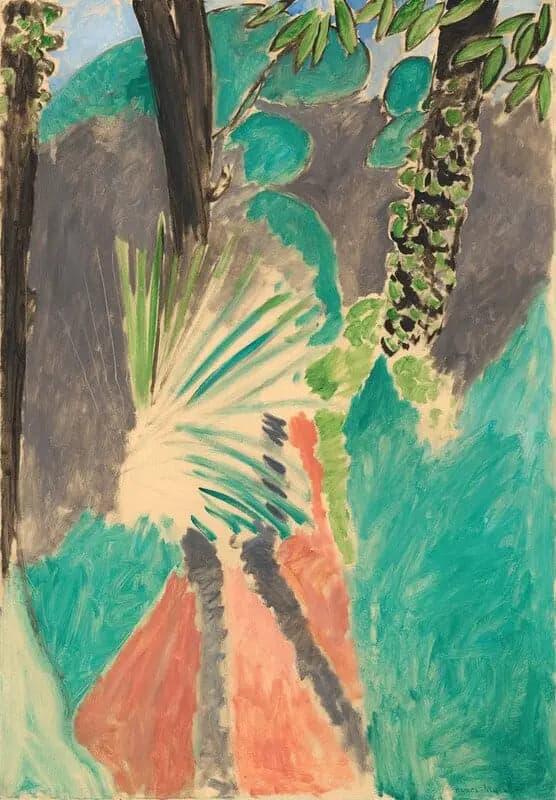
Palm Leaf, Tangier
- Original dimensions
- 81.9 x 117.5 cm
- Museum
- National Gallery of Art
- Year
- 1912
Scene depicted
The composition of this canvas immediately immerses us in a sensory universe where the lush green of the leaves is illuminated under a brilliant sun. The leaf, majestically isolated, becomes a symbol of place and time, while revealing the simple and pure beauty of nature. The fluid contours and vibrant colors intertwine to create a pictorial work that celebrates nature and the unbridled spirit of Fauvism .
Historical context
Created in 1912, in the enchanting city of Tangier, this painting embodies the essence of Fauvism , an artistic movement that celebrates color and light. Rooted in a rich cultural context steeped in history, the canvas is part of the tradition of painters who found inspiration in exotic landscapes. Currently housed at the National Gallery of Art , this masterful work fascinates with its generous dimensions and vibrant energy.
Place in the artist's career
Palm Leaf, Tangier is part of a pivotal period in Matisse's career, where he begins to explore bolder forms and colors. Alongside works like The Dance and The Joy of Life , this canvas illustrates his artistic evolution towards a more radical stylization, which will be decisive for the rest of his work.
Anecdote
"In every leaf, I see the dance of the sun." One spring morning, as Matisse walked through the sunny streets of Tangier, his gaze was captivated by the delicacy of a palm leaf caressed by the wind. This fleeting emotion is immortalized in his masterpiece , Palm Leaf, Tangier , which evokes an atmosphere of lightness and joy of living.