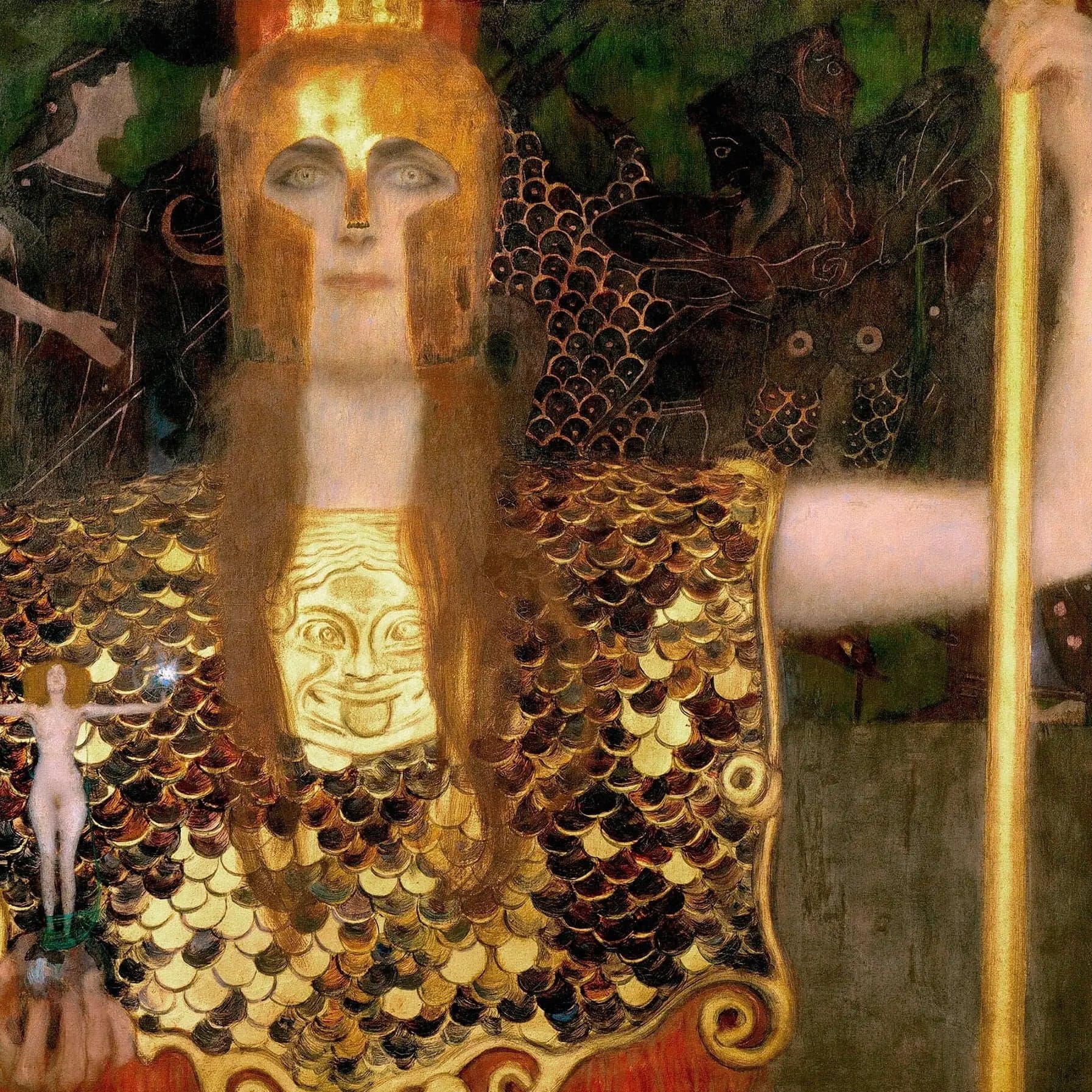
Pallas Athena
- Original dimensions
- 75 x 75 cm
- Museum
- Vienna Museum
- Year
- 1899
Scene depicted
In this masterful pictorial work, Klimt depicts the goddess Pallas Athéna, symbol of wisdom and war, clad in a shimmering armor adorned with gold and symbolic ornaments. She emerges from a golden background, bathed in light, her imposing and protective presence immediately draws the eye. This painting illustrates feminine power, blending both strength and delicacy, a manifesto in favor of the modernity of her time.
Historical context
Year: 1899 |BRK| Museum: Vienna Museum |BRK| Dimensions: 75 x 75 cm
Place in the artist's career
Pallas Athéna represents a stylistic peak in Klimt's career, marking a spectacular evolution in his approach to feminine themes and ornamentation. At a crossroads, this painting particularly stands between The Kiss which celebrates sensual love and Portrait of Adele Bloch-Bauer I , which explores the mystery of identity. Here, Klimt refines his mastery of visual language, combining sensuality and power.
Anecdote
“I seek to capture the spirit of beauty through my canvases.” Thus, Gustav Klimt evokes the inspiration behind his masterpiece . It was a spring morning in Vienna, when light filtered through the blooming trees, illuminating silent alleys. It is in this inspiring atmosphere that the evocative power of Pallas Athéna took shape, transcending time and space.