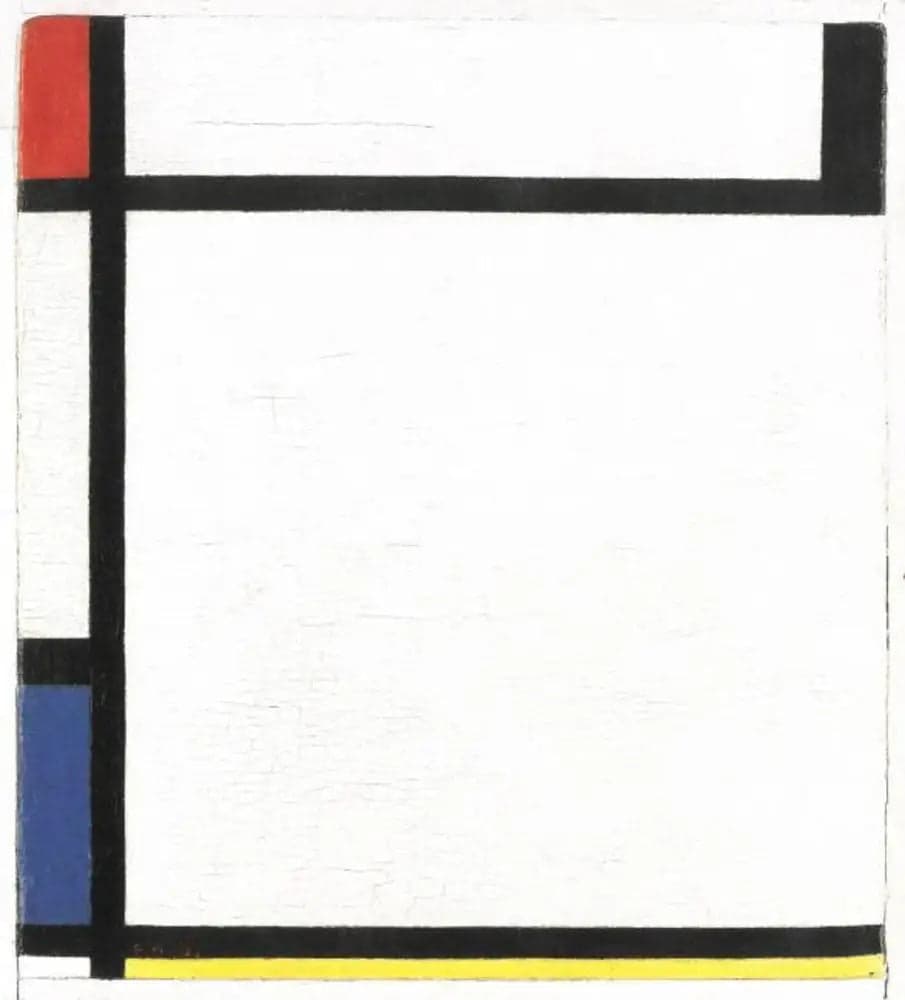
Painting No. XI
- Original dimensions
- 34.5 x 38.5 cm
- Museum
- Kaiser Wilhelm Museum
- Year
- 1922
Scene depicted
This pictorial work, typical of Mondrian 's unique style, represents a bold composition of horizontal and vertical lines, intercrossing with perfect harmony. The blocks of primary color illustrate the tension between order and chaos, revealing the artist's search for purity and modern expression, while paying homage to abstraction. The dialogue between the vibrant shades of red, yellow, and blue, and white, offers a sensation of light and dynamism that captures the eye and the mind.
Historical context
Year: 1922 |BRK| Museum: Kaiser Wilhelm Museum |BRK| Dimensions: 34.5 x 38.5 cm
Place in the artist's career
Painting No. XI marks a turning point in Mondrian 's career, illustrating the peak of his style. This masterpiece is often paralleled with his earlier works, such as “Composition in Red, Blue, and Yellow” and “Grid Composition,” where one can observe an evolution towards an increasingly pronounced abstraction and a mastery of the relationships between color and form.
Anecdote
“The artwork is the echo of universal order.” This profound thought by Mondrian resonates like a mantra during the creation of the piece. Inspired by the structure of cities and the rhythms of modern life, he often strolled through bustling alleys, where at every corner, he perceived symphonies of shapes and colors that awakened him. It was on a spring morning, cradled by the soft light, that he sketched the first lines of this masterpiece .