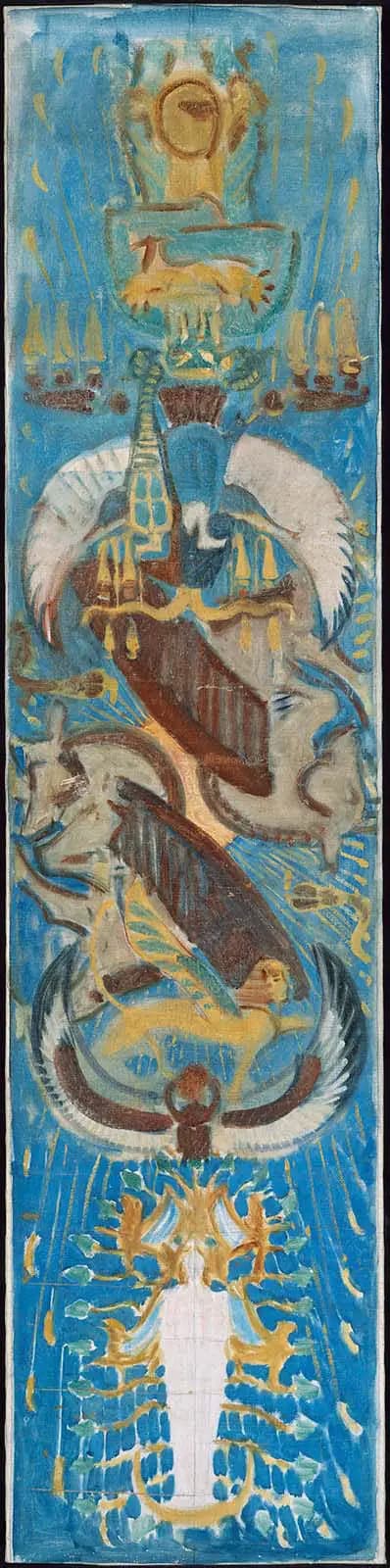
Pagan Deities
- Original dimensions
- 132.08 x 31.75 cm
- Museum
- Museum of Fine Arts Boston
- Year
- 1892
Scene depicted
In Pagan Deities , Sargent invites the viewer to travel into a mythological world. The composition evokes ancient deities, surrounded by lush vegetation, where light plays a crucial role, illuminating faces imbued with mystery and emotion. Each character seems alive, almost palpable, as if they were whispering secrets into the ears of those who dare to look.
Historical context
Created in 1892, in Boston, this painting is emblematic of the artistic movement of realism , which combines meticulous observation with original expression. At the heart of the late 19th century, a time of renewal and creativity, Pagan Deities finds its place in the Museum of Fine Arts Boston , where it still speaks to us today through its majestic dimensions.
Place in the artist's career
Pagan Deities marks a significant milestone in Sargent's career. This painting demonstrates his mastery of light and color, similar to works such as “Carnation, Lily, Lily, Rose” and “The Specialty of Portraiture” which highlight his stylistic evolution. With this painting , he reveals himself not only as an exceptional portraitist but also as a visual storyteller of mythologies.
Anecdote
John Singer Sargent once stated: “Every painting is an adventure, an opportunity to discover hidden truths.” This pictorial work came to life on a gentle spring morning, where the artist, inspired by the surrounding nature, captured the essence of a forgotten legend in the whispers of the forest.