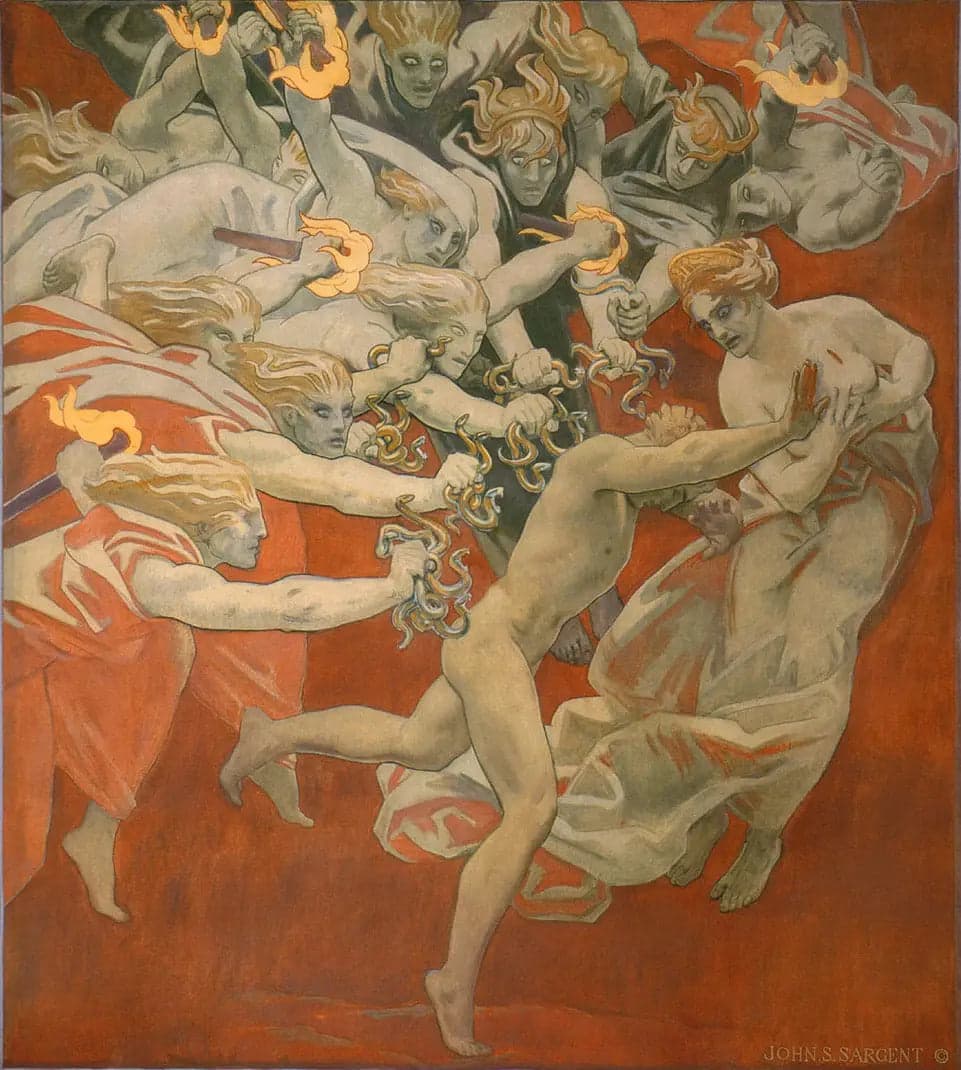
Oreste
- Original dimensions
- 317.5 x 347.98 cm
- Museum
- Museum of Fine Arts Boston
- Year
- 1921
Scene depicted
In the painting “Oreste,” John Singer Sargent illustrates a dramatic scene, evoking themes of tragedy and passion. The composition depicts an intense moment, where the character of Oreste, a symbol of vengeance, confronts tumultuous emotions, capturing the very essence of Greek tragedy. The palpable tension between the figures and the bold use of light create an immersive atmosphere that invites the viewer into the narrative.
Historical context
Created in 1921, in the historic city of Boston, this painting is part of an artistic movement transitioning between realism and modernism, illustrating the evolution of visual perceptions of the time. The canvas , currently exhibited at the Museum of Fine Arts Boston , bears witness to a rich cultural heritage and impressive technical mastery.
Place in the artist's career
“Oreste” fits into a mature period of Sargent's career, where his mastery of painting intertwines with a bolder exploration of emotional themes. This canvas can be compared to other works such as “Madame X” and “The Garden of the Villa of the Queen,” highlighting the evolution of his techniques and the psychological depth of his artistic production.
Anecdote
John Singer Sargent once stated: “Painting is a moment of life captured on a canvas ”—a phrase that resonates particularly when discovering the masterpiece “Oreste.” This work was inspired on a sunny morning, where the artist found refuge in the shadows of a park, allowing emotions to guide him in the complex composition of this painting .