Onions - Pierre
- Original dimensions
- 60.6 x 39.1 cm
- Museum
- Clark Art Institute
- Year
- 1881
Scene depicted
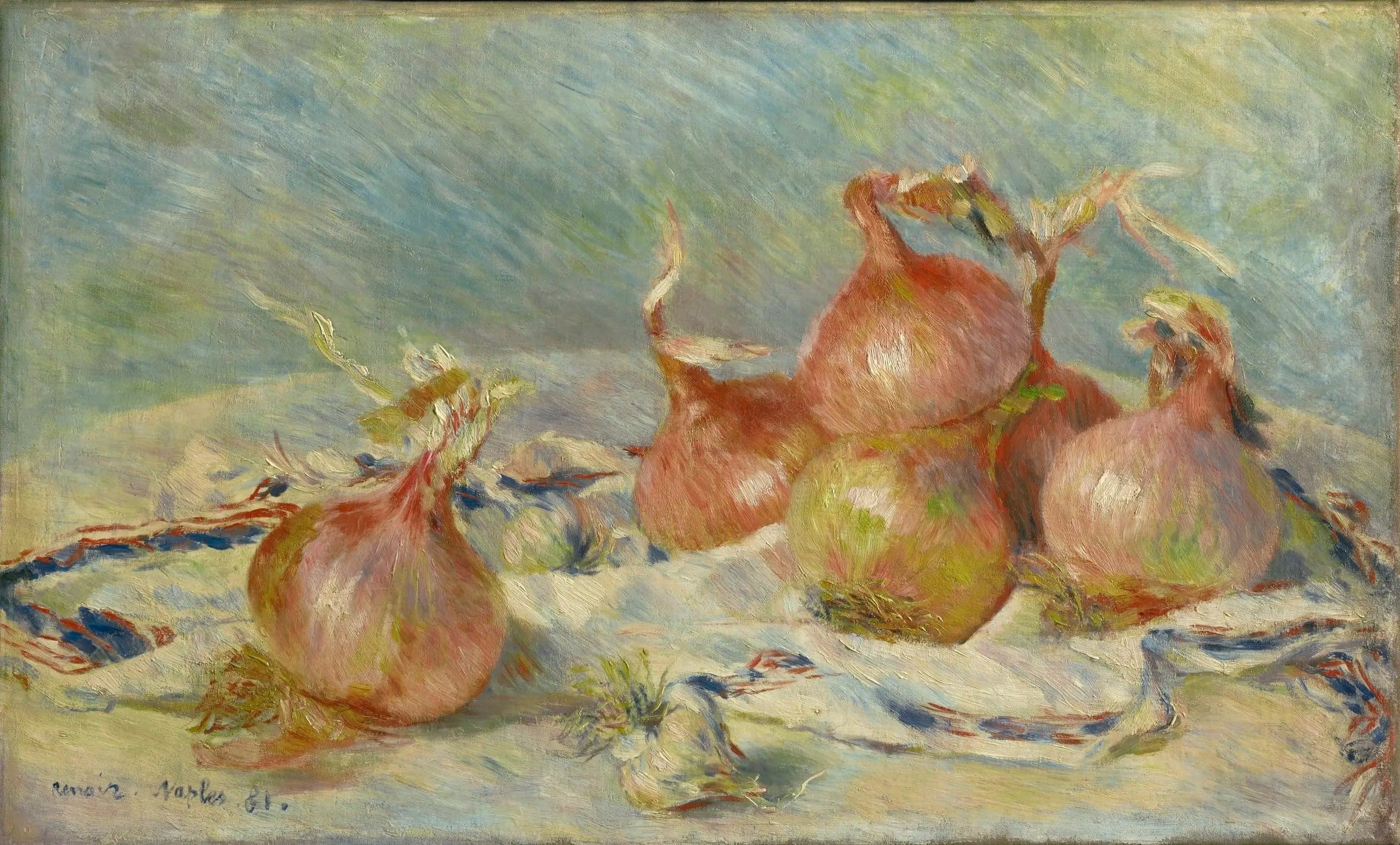
In this delicate composition, Renoir sublimates the ordinary, bringing together in visual harmony onions, silent witnesses of a bygone kitchen. Near a nuanced background that evokes the ambiance of soft light, each onion is painted with such tenderness that they seem almost alive, rising beyond their mere existence to evoke buried memories and sensations.
Historical context
Created in 1881, this painting masterfully emanates from a vibrant period at the height of the Impressionist movement in Paris, where light is unleashed and colors come to life. The painting, currently preserved at the prestigious Clark Art Institute , resonates with the spirit of an era where nature and scenes of everyday life are celebrated in all their splendor, inviting serene contemplation in front of such a delicately executed pictorial work.
Place in the artist's career
The painting Onions positions itself at a key moment in Renoir's career, revealing a touch of maturity in his approach. Compared to other iconic pieces, such as Luncheon of the Boating Party and Dance in the City, Onions reveals a shift towards deeper introspection. Through this work, Renoir experiments with the blur of sensory beauty through a canvas that blends simplicity and richness of impressions.
Anecdote
“When it rains, light becomes a perfume of gold and brilliance,” Renoir might have said about the importance of light in his works. One spring morning, while strolling through an alley in southern France, a simple bunch of onions inspired him. Thus, the scene of Onions captured an ephemeral moment that resonates with the tranquil beauty of everyday life, awakening a sweet memory, and transforming a humble subject into a masterpiece .