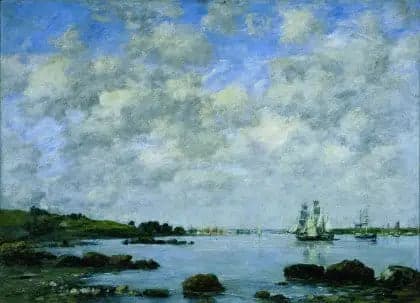
On the Meuse
- Original dimensions
- 71 x 53 cm
- Museum
- Kreeger Museum
- Year
- 1883
Scene depicted
In this work, Boudin depicts a serene scene where light dances on the peaceful waters of the Meuse. The sky, a bright blue, seems to reflect in the calm surface of the water, while light boats weave through the landscape. This harmony between nature and human activity is beautifully captured, testifying to a fragile balance and ephemeral beauty that only a canvas can convey so accurately.
Historical context
Created in 1883, On the Meuse is an emblematic work of the Impressionist movement, an artistic movement that emerged in France in the 19th century. This painting captures the beauty of the Meuse, an emblematic river that flows through France, symbolizing a vibrant and free nature. Currently exhibited at the Kreeger Museum , this canvas reflects a moment of introspection and tranquility, typical of the time when Boudin sought to immortalize evolving natural landscapes.
Place in the artist's career
On the Meuse represents a turning point in the career of Eugène Boudin , consolidating his reputation as one of the pioneers of Impressionism . This canvas is often paralleled with works such as The Port of Deauville and The Boats of Honfleur , where the artist also explores themes related to nature and maritime life, thus showing his technical and emotional evolution.
Anecdote
“Nature is my most beautiful muse, it inspires me.” These words from Eugène Boudin resonate through every brushstroke of his masterpiece . Imagine him, one spring morning, on the banks of the Meuse, the slight chill of the cold air contrasting with the warmth of the rising sun. This moment of intense inspiration gave birth to the painting you admire today.