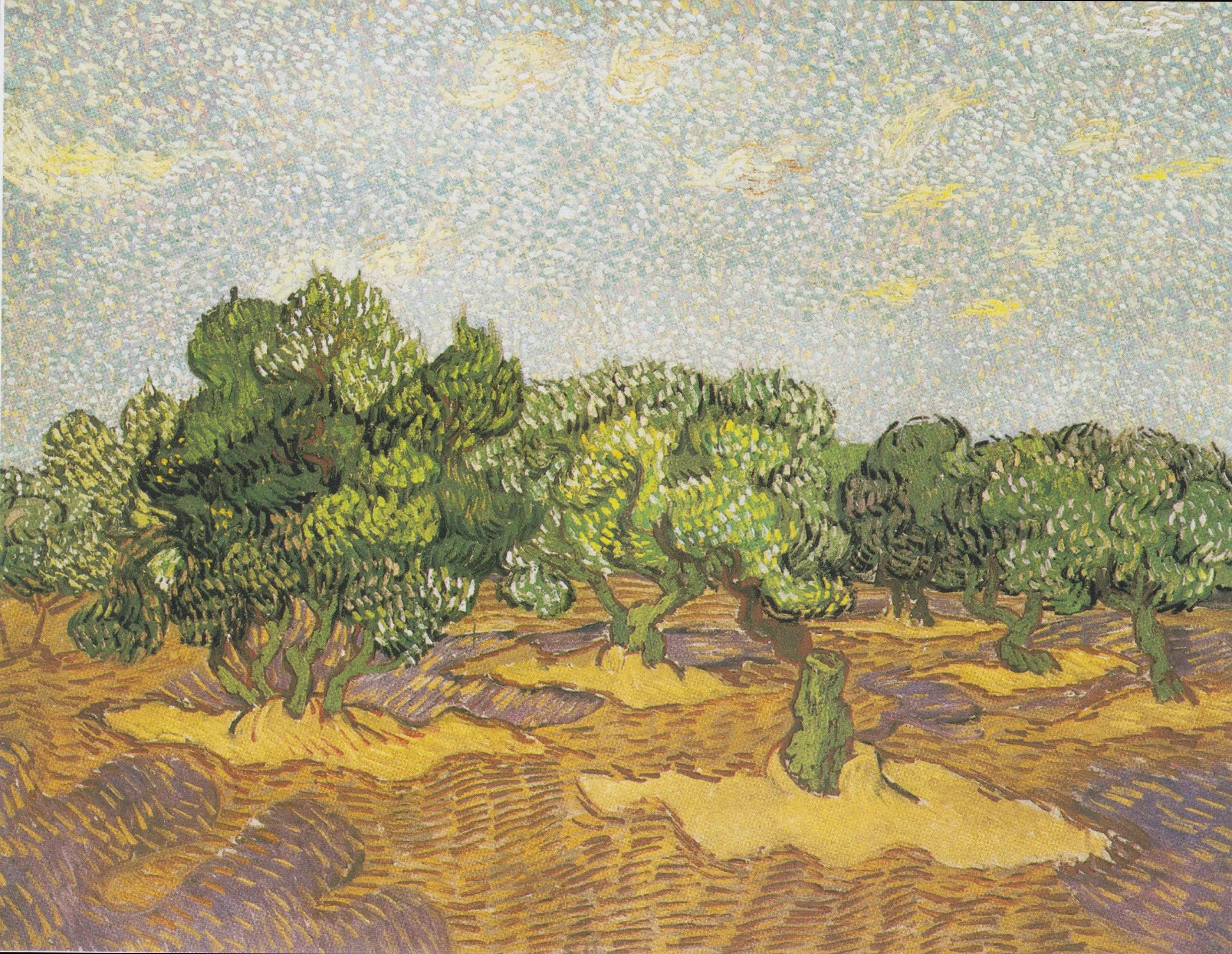
Olive Trees
Scene depicted
The painting "Olives" vividly captures the quiet strength of the centennial trees, symbols of resilience and the soothing presence of nature. Here, the light plays with the leaves, revealing infinite shades of green under a Provençal sky. The sinuous contours of the olive trees, the epicenter of the composition, speak of a living, tender, and emotional world.
Historical context
Created in 1889 in the charming town of Saint-Rémy-de-Provence , this painting brilliantly fits into the post-impressionist movement, characteristic of the work of Vincent van Gogh . At that time, the artist finds refuge in this serene setting, away from his inner turmoil. Today, the canvas proudly resides at the Metropolitan Museum of Art in New York, measuring 92.1 x 72.7 cm.
Place in the artist's career
This canvas represents a key moment in Van Gogh's career, reflecting his artistic maturity. At this time, his style evolves towards more emotional compositions, as evidenced by " Starry Night " and " The Bedroom of Van Gogh in Arles ". Through "Olives," one perceives a growing harmony between technique and feeling.
Anecdote
Vincent, enamored with nature, often declared: "Nature is a garden made for emotion." It is in the heart of these olive trees, at dawn, that his thoughts awaken. Each brushstroke in the canvas translates his quest for peace and expression in the robustness of the trees, in the soft morning light.