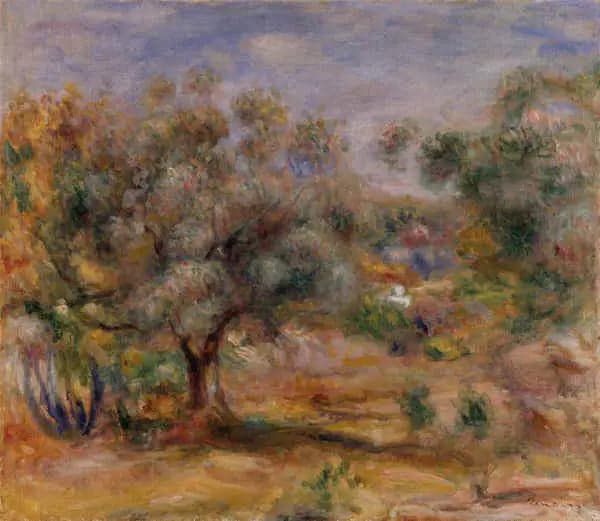
Olive Trees in the Garden of Collettes - Pierre
- Original dimensions
- 51 x 44 cm
- Museum
- Kunsthalle Bremen
- Year
- 1910
Scene depicted
In this pictorial work , the olive trees stand majestically, surrounding a serene space where nature seems to flourish. The bright sunlight filters through the foliage, creating a play of shadow and light that conveys the sweetness of summer days. Every detail of this canvas evokes the sensations of a lush garden, where peace and beauty coexist.
Historical context
Created in 1910, this painting is emblematic of the Impressionist movement, a time when Renoir explored the beauty of landscapes and gardens. Located in Bremen, Germany, the canvas captures the essence of Mediterranean nature, a memory of his stays in the south of France, where light dances through the leaves of the olive trees. Currently, this work is preserved at the Kunsthalle Bremen .
Place in the artist's career
This painting represents a matured phase of the artist, where his style becomes freer and imbued with emotion. Compared to his earlier works such as Lunch of the Boaters and Dancing at Bougival , Olives in the Garden of Collettes reflects his evolution towards a more fluid and Impressionist aesthetic, capturing the moment with a unique poetry.
Anecdote
Renoir reportedly stated: "Nature itself is the inspiration. One just needs to know how to look." It was in the intimacy of his garden on a spring morning that this composition came to life, inspiring the master to capture the harmony between light and vegetation, at the heart of the painting .