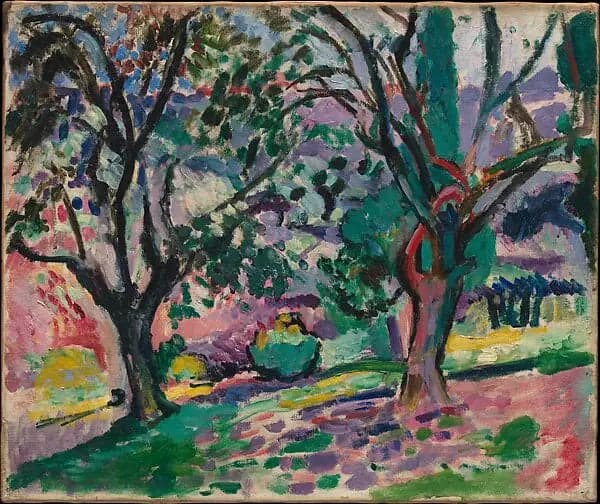
Olive Trees in Collioure
- Original dimensions
- 55 x 46 cm
- Movement
- fauvism
- Museum
- Metropolitan Museum of Art
- Year
- 1906
Scene depicted
In Oliviers à Collioure , a vibrant landscape unfolds under the viewer's eye, revealing majestic olive trees bathed in golden light. The composition, rich in shades and textures, evokes a Mediterranean atmosphere, filled with the scent of olive oils and the warmth of the sun. The stylized forms and bold use of colors transport the gaze into a contemplative experience, making this canvas an invitation to rediscover natural beauty.
Historical context
Created in 1906, this iconic painting finds its essence in the charming coastal town of Collioure, France. Belonging to the fauvist movement, Oliviers à Collioure represents a period when art breaks free from conventions, embracing vibrant colors and raw emotions. Currently exhibited at the Metropolitan Museum of Art , this painting elegantly measures 55 by 46 centimeters, embodying the vitality of the early 20th-century artistic movement.
Place in the artist's career
Oliviers à Collioure marks a turning point in Matisse's career, where he exhumes the quintessence of his unique style. Situated between the early experiments of fauvism and more mature works like LaDanse and La Musique , this painting illustrates the transition to a bolder exploration of colors and emotions, establishing a bridge to future masterpieces.
Anecdote
“Color is the symbol of my search for harmony.” This quote from Matisse evokes the genesis of Oliviers à Collioure , inspired by a bright morning, where the softness of the sea breeze arranged the leaves of the olive trees in a colorful dance. In this picturesque place, each brushstroke managed to capture the soul of ephemeral beauty, transforming the painting into a visual poem.