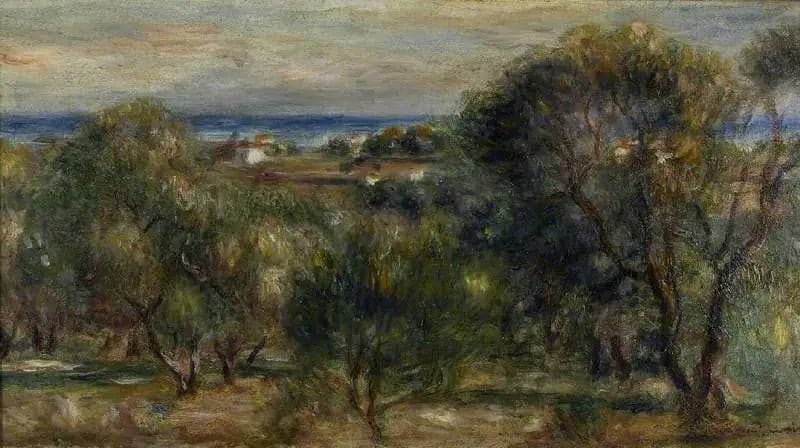
Olive Trees, Cagnes - Pierre
- Original dimensions
- 45.2 x 24.5 cm
- Museum
- Fitzwilliam Museum
- Year
- 1913
Scene depicted
The painting “Oliviers, Cagnes” transposes before our eyes a rural landscape where nature seems to vibrate to the rhythm of Renoir's palette. Majestic olive trees draw a lush tableau against a playful sky, evoking a peaceful and serene atmosphere. Each brushstroke breathes harmony, and every detail seems to sing the beauty of a moment stolen from reality.
Historical context
Created in 1913, this painting emblematic captures the essence of Provençal, region where Renoir finds his fertile inspiration. At the heart of a vibrant France, this canvas fits perfectly into the impressionist movement, celebrating light and nature in all their splendor. Currently exhibited at the Fitzwilliam Museum , this work of modest dimension testifies to a historical moment where color and form unite to tell a timeless story.
Place in the artist's career
This painting , made at a time when Renoir is already recognized as a master of impressionism , marks a turning point in his technique. Alongside other works such as “Luncheon of the Boating Party” and “Dance in the City,” this canvas demonstrates a stylistic maturation, where light and color become full-fledged protagonists, conferring unprecedented depth and palpable emotion.
Anecdote
Renoir once declared: “The joy of living is hidden in the light,” a quote that resonates powerfully with the creation of this masterpiece. It may have been a radiant morning, bathed in the scents of blooming olive trees, that inspired the artist in this alley of Cagnes-sur-Mer. It is at this precise moment that the canvas witnessed the birth of this vibrant emotion, blending the scent of flowers with the song of birds, creating a sensual symphony.