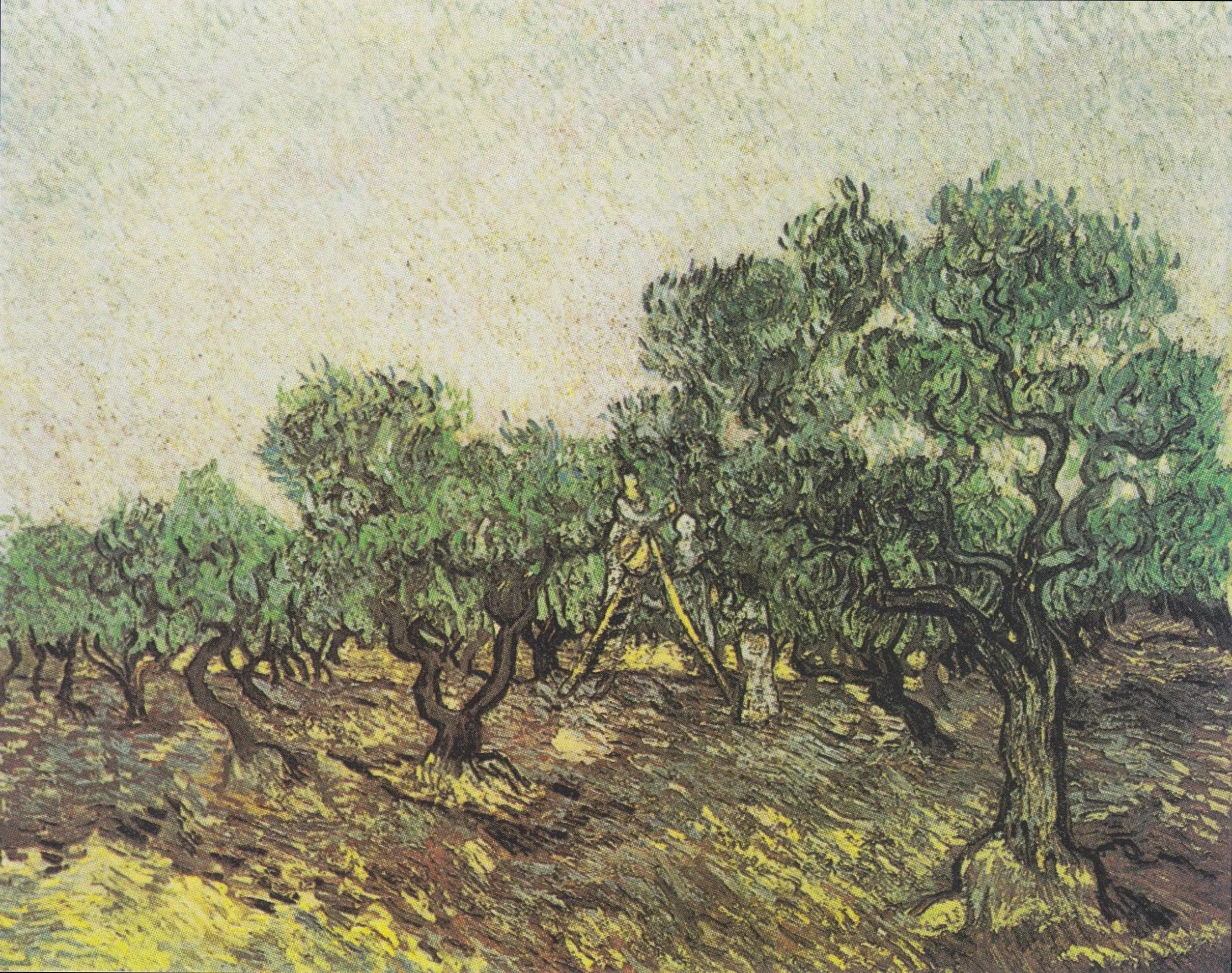
Olive Harvest
- Original dimensions
- 92 x 73 cm
- Museum
- Vassílis and Elísa Goulandrís Foundation
- Year
- 1889
Scene depicted
In the canvas Olive Harvest , Vincent van Gogh captures a moment of hard work outdoors, where the act of harvesting intertwines with the dance of light. Human figures, immersed in their task, are surrounded by lush foliage, creating a vibrant yet peaceful atmosphere. Light pierces through the branches, and one can almost hear the rustling of leaves and smell the scent of olive trees laden with fruit.
Historical context
Created in 1889 in the charming town of Saint-Rémy-de-Provence , Olive Harvest belongs to the post-impressionist period, an artistic movement that seeks to express emotion and light rather than simply capture reality. This iconic painting is now housed at the Vassílis and Elísa Goulandrís Foundation , where it inspires visitors every day with its depth and sensitivity.
Place in the artist's career
Olive Harvest is situated at a pivotal moment in Vincent van Gogh 's career. After a period of anguish and uncertainty, this masterpiece represents both a technical achievement and a stylistic maturation. Alongside Starry Night and Sunflowers , this canvas reveals an evolution towards a bolder and more emotional approach, where color and texture play a crucial role in visual storytelling.
Anecdote
“I want to paint dreams...,” said Vincent van Gogh , searching in each painting for a way to materialize his inner universe. It was on a misty morning in Provence, amidst the leafy olive trees, that he was struck by the lucid beauty of processes as simple as fruit harvesting. The painting invites us to share this contemplation, echoing ancient rituals and nature awakening.