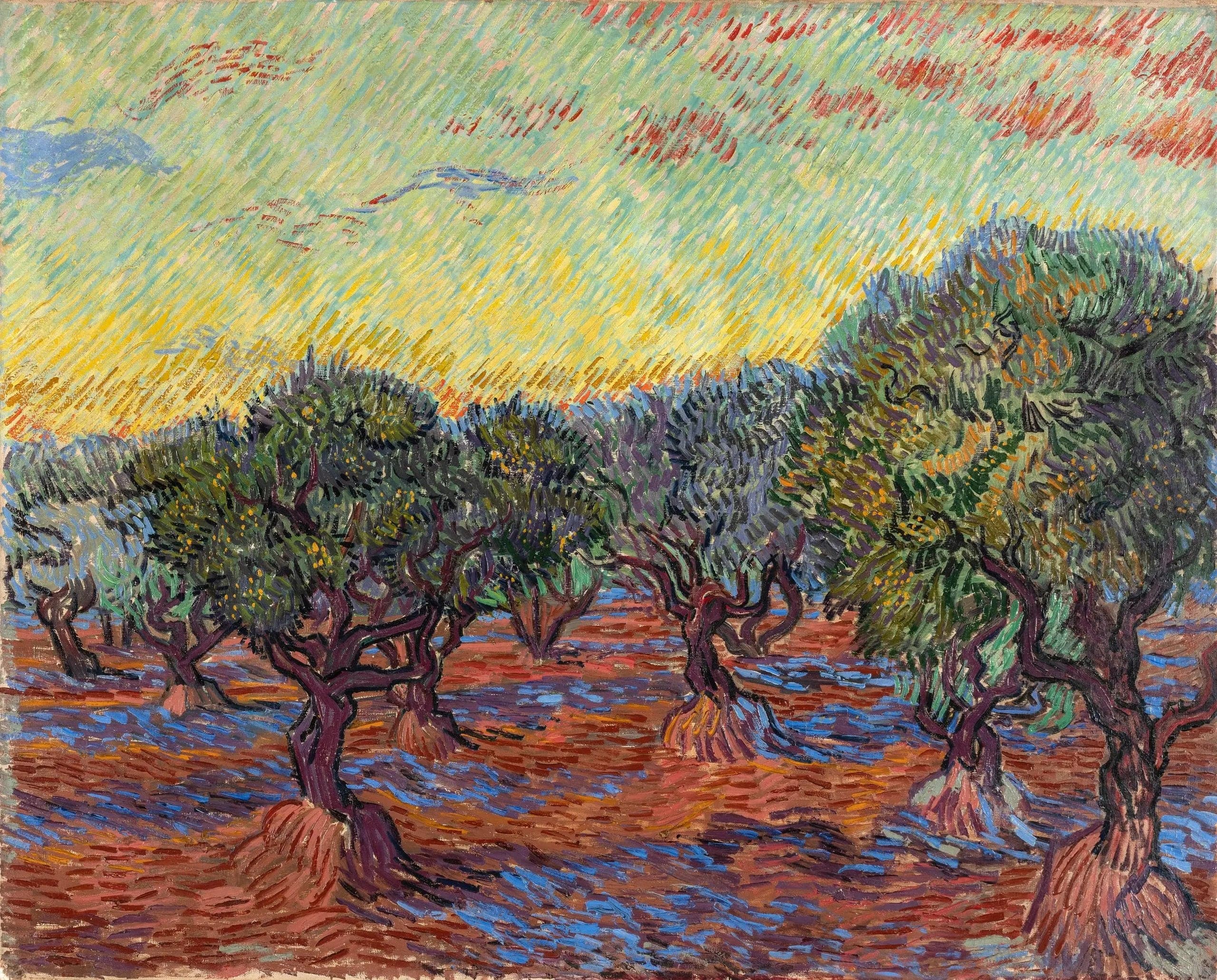
Olive Grove, Saint-Rémy
- Original dimensions
- 93 x 74 cm
- Museum
- Gothenburg Museum of Fine Arts
- Year
- 1889
Scene depicted
In the painting “Olive Grove, Saint-Rémy,” a forest of olive trees emerges amidst a rolling landscape , each tree bearing the weight of years and a silent wisdom. The ochre and vibrant sky, traversed by clouds, adds dramatic depth to this scene that interacts with light. It is an ode to nature, full of life, where the gaze gets lost in the delicate shades of foliage.
Historical context
Created in 1889 in Saint-Rémy-de-Provence , this iconic painting is part of the post-impressionist movement. Rooted in the turmoil of Vincent van Gogh's life, it reflects an intimate and personal moment in his career as he sought refuge and inspiration amidst nature. Today, this canvas is housed in the Gothenburg Museum of Fine Arts , where it continues to evoke emotions.
Place in the artist's career
This painting is situated at a pivotal moment in Vincent van Gogh's career. It illustrates his transition to a bolder and more expressive palette, comparable to works like “The Irises ” and “ The Starry Night .” Each of these canvases reflects a technical and emotional evolution, showcasing his creative genius in full bloom.
Anecdote
“I have always believed that the memory of the ardors of light is what drives me to paint.” With this phrase, one can imagine Vincent in his garden, in the early morning of a Provençal spring, inhaling the scents of olive and thyme. It was undoubtedly a moment of revelation, the seed of his masterpiece , the Olive Grove .