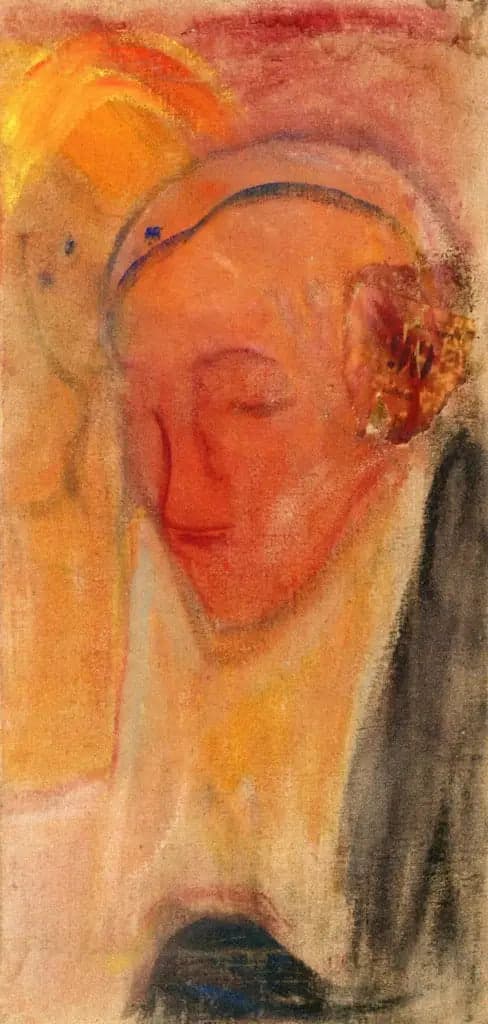
Old Bearded Man
- Original dimensions
- 29 x 59.5 cm
- Museum
- Munch Museum
- Year
- 1897
Scene depicted
The painting "Old Bearded Man" represents an isolated character, whose marked features evoke both wisdom and suffering. His resigned posture and melancholic gaze anchor this canvas in a reflection on the human condition, driven by the quest for an authentic connection to the world.
Historical context
This painting emblematic was born at the end of the 19th century, in Oslo, a lively city that was steeped in the effervescence of symbolism . Munch, a leading figure of this artistic movement, dedicated himself to a resolutely emotional art. The canvas is today preserved at the Munch Museum, where it testifies to the intensity of human emotions through its poignant gaze.
Place in the artist's career
This canvas is at the heart of Munch's artistic maturation, marking a transition to more introspective works. Alongside other canvases like "The Scream" and "The Madonna," "Old Bearded Man" illustrates the evolution of his technique and emotional quest, seeking to capture the very essence of existence.
Anecdote
Edvard Munch often stated: "Art is an emotion transmitted," a thought that resonates in the creation of this masterpiece . The moment he captured the essence of this old bearded man took place at the bend of a path, on a misty morning, where the light filtered through the clouds inspired the depth of his canvas .