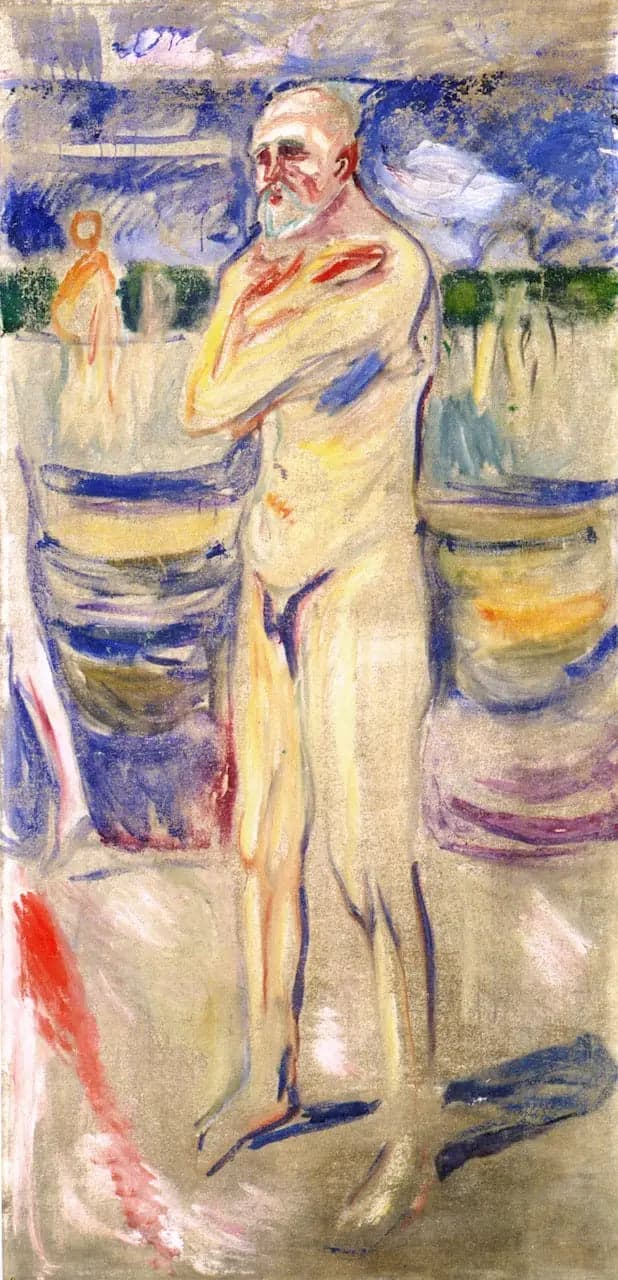
Old Age
- Original dimensions
- 97 x 200.5 cm
- Museum
- Munch Museum
- Year
- 1908
Scene depicted
This painting depicts the solitude and nostalgia of an aging man, at the twilight of his life. The French work evokes distant memories, where every detail captures the intensity of human emotions. Munch represents vulnerability in the face of time, thus offering a profound reflection on existence and death.
Historical context
Created in 1908 in Oslo, this painting is part of the expressionist movement. Edvard Munch , an iconic figure of the 19th century, was able to capture human emotions through his works. The painting is now exhibited at the Munch Museum, where it remains a powerful symbol of the complexity of life and death.
Place in the artist's career
“Old Age” represents a mature phase of Munch's career, where his technique becomes more assertive. In parallel with “The Scream” and “The Madonna,” this painting shows a stylistic evolution from a violent expression of emotions to more poignant representations of human vulnerability.
Anecdote
“Human life is a huge canvas, every hour of joy and pain weaves its own colors,” said Munch, inspired by his näbeste cente. Imagine him painting “Old Age” on a misty morning, a serene silence enveloping his studio, while the memories of faces from the past haunt him.
Major exhibitions
Munch og Warnemünde: 1907-1908