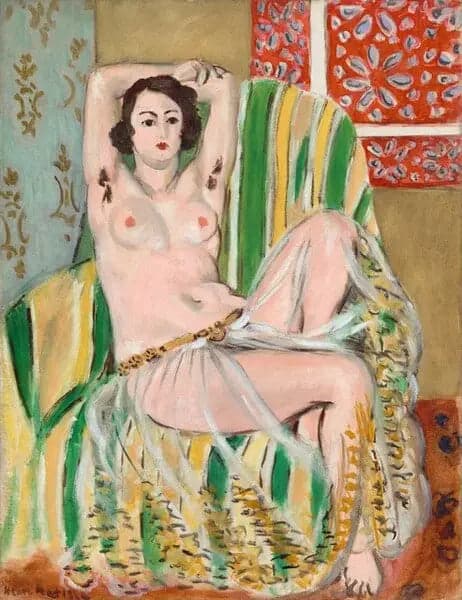
Odalisque with Raised Arms
- Original dimensions
- 50.2 x 65.1 cm
- Museum
- National Gallery of Art
- Year
- 1923
Scene depicted
In "Odalisque aux bras levés", Matisse invites us to contemplate a woman of exceptional refinement, her posture evoking both serenity and a certain vulnerability. The scene is imbued with intimacy, transporting the viewer into a universe that is both sensual and poetic. Through the fluidity of its lines and the harmony of its colors, the painting creates a dreamlike atmosphere where everything seems suspended in time.
Historical context
Created in 1923, in the vibrant city of Paris, the painting "Odalisque aux bras levés" belongs to the Fauvist movement, famous for its bright colors and bold shapes. At that time, Paris became the cultural crossroads of the world, bringing together artists, writers, and thinkers. This canvas , exhibited at the National Gallery of Art , remains a striking illustration of the creative effervescence of that era. With its dimensions of 50.2 x 65.1 cm, this canvas asserts itself with its presence and brilliance.
Place in the artist's career
"Odalisque aux bras levés" represents a crucial step in Matisse's career, illustrating both his mature style and his mastery of forms. In parallel with his famous "Dance" and "The Joy of Life", this masterpiece highlights his evolution towards a more colorful and bold abstraction, affirming his predominant role in Fauvism .
Anecdote
“True painting is not defined, it is felt.” such was Matisse's thought, revealing his admiration for spontaneity. Imagine him one sunny morning, in his studio bathed in golden light, inspired by a delicate silhouette. This is how this pictorial work was born, imbued with the emotions of the moment.