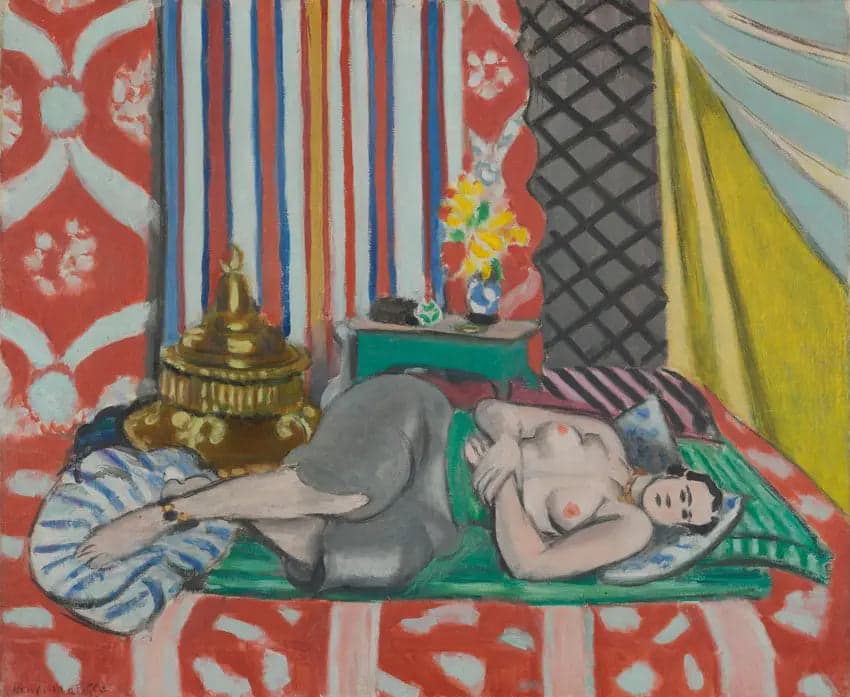
Odalisque with Gray Panties
- Original dimensions
- 65 x 54 cm
- Museum
- musée de l'Orangerie
- Year
- 1927
Scene depicted
The painting "Odalisque à la culotte grise" depicts an elegant woman, in a languorous pose, draped in sumptuous fabrics that evoke the sensuality and tranquility of the harem. This composition, both captivating and mysterious, questions the notion of beauty and the representation of the female body through the eyes of a master of color.
Historical context
The iconic work known as Odalisque à la culotte grise was created in 1927, in the vibrant setting of 1920s Paris. This painting is a powerful illustration of the Fauvist style, an artistic movement that Matisse helped to establish. Today, this painting is housed in the musée de l'Orangerie in Paris, where it continues to inspire visitors with its virtuosity and unique aesthetic.
Place in the artist's career
Odalisque à la culotte grise represents a milestone in Matisse's career, marking his period of artistic maturity. Generating both boldness and delicacy, this masterpiece is often paralleled with works such as "La Danse" and "Le Bonheur de Vivre," which show a significant evolution in his technique and aesthetic vision.
Anecdote
Henri Matisse once stated: "Color must be an emotion." This quote resonates deeply with the genesis of Odalisque à la culotte grise , painted on a sunny morning when the artist was inspired by the soft shadows playing on the faces of the models he encountered. This intimate connection with light and the forms of the canvas is embodied in every brushstroke, transcending mere visual pleasure.
Major exhibitions
Matisse. Cahiers d'art, the turning point of the 1930s