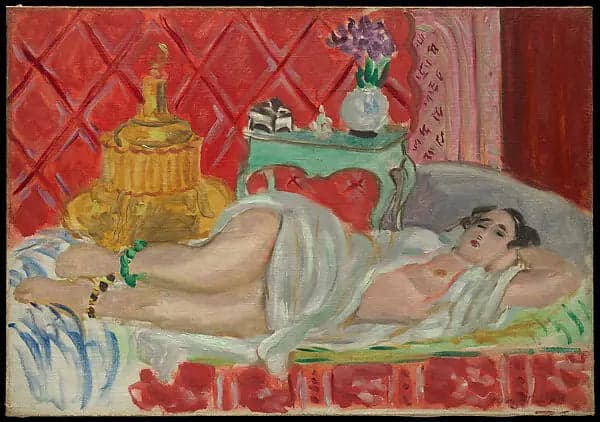
Odalisque, red harmony
- Original dimensions
- 54.9 x 38.4 cm
- Museum
- Metropolitan Museum of Art
- Year
- 1926
Scene depicted
In this canvas , Matisse immerses us in the heart of an intimate scene, where an odalisque rests peacefully, surrounded by patches of vibrant colors. The voluptuous shapes and palette contrasts evoke the sensuality and warmth of the East, creating a universe that is both welcoming and mysterious. This composition reflects Matisse's fascination with light and color, transforming a simple scene of rest into a true visual poem.
Historical context
Created in 1926, this painting emblematic of Matisse is at the heart of the artistic effervescence of Paris in the Roaring Twenties. Matisse, master of fauvism , captured the vibrant spirit of his time, navigating between boldness and delicacy. The canvas , currently exhibited at the Metropolitan Museum of Art in New York, reveals dimensions of 54.9 x 38.4 cm, testifying to the intimacy of such a masterpiece.
Place in the artist's career
This painting marks a turning point in Matisse's career, encapsulating his distinctive style at a time when he sought to explore beyond traditional forms. In parallel, works such as “The Dance” and “The Joy of Life” show the evolution of his pictorial language, constantly challenging him to explore the break with the artistic conventions of his time.
Anecdote
“Color, for me, is a joy, a way to capture the beauty of a moment.” Against the backdrop of a gentle spring light, Matisse let his imagination run free by evoking the universe of odalisques, those Eastern women who inspired him so much. This painting thus becomes a window into this beauty suspended in time.
Major exhibitions
Twentieth-Century Modern Masters: The Jacques and Natasha Gelman Collection