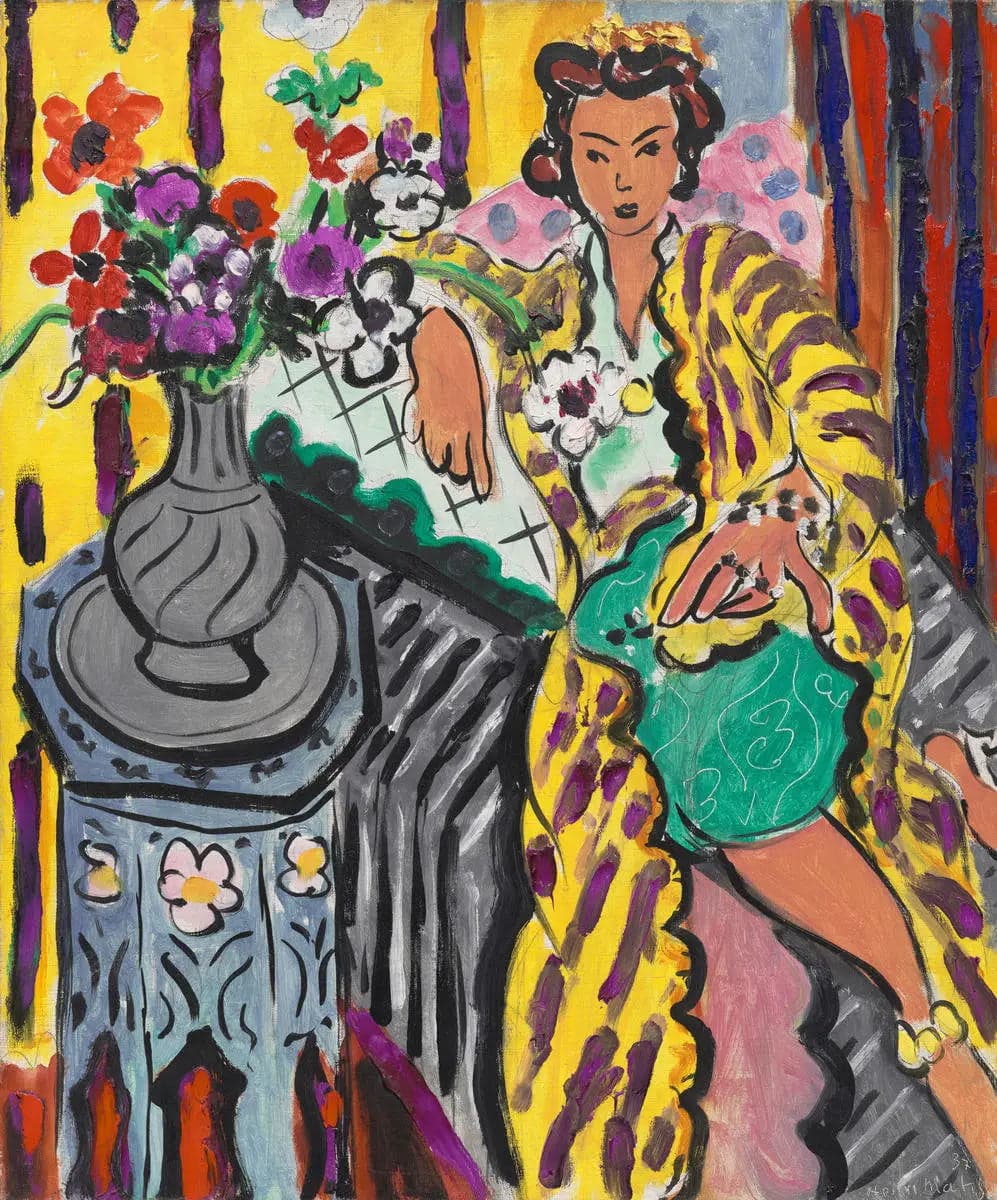
Odalisque in a Yellow Persian Dress
- Original dimensions
- 46 x 55.2 cm
- Museum
- Philadelphia Museum of Art
- Year
- 1937
Scene depicted
This painting reveals a peaceful odalisque, wrapped in an enchanting yellow Persian dress, who seems to invite contemplation. The contrast between the intimacy of the character and the abundance of patterns creates a universe where the viewer is transported. The light, soft and golden, caresses the satin skin of the heroine while the background echoes a rich Eastern culture, reflecting the influence of Matisse's travels at the time on his art.
Historical context
Created in the heart of the 1930s, this iconic painting is set in a cultural context where modernity and exoticism intertwine. Located in Philadelphia, this work is a striking representation of Fauvism , an artistic movement of which Matisse is a pillar. The painting is currently housed at the Philadelphia Museum of Art , a prestigious conservation site that honors this masterpiece with care.
Place in the artist's career
This painting is situated at a decisive turning point in Matisse's career. After a phase of stylistic exploration, he asserts himself with the clarity of his palette. Alongside other major works like The Dance and The Women of Algiers , "Odalisque à la robe persane jaune" represents a period where his technical and emotional mastery reaches new heights. The evolution of his style, moving from Fauvist rigor to a more pronounced sensuality, is strikingly evident here.
Anecdote
“In every area of color, there is a breath of life.” Such would be Matisse's words evoking the importance of color in his work. Strolling through the sunny streets of Nice, one spring morning, the artist crosses the gaze of an odalisque, a soft and ethereal silhouette. This ephemeral encounter finds its vibrant echo in the study of the delicacy of the composition of the painting , where the yellow Persian dress becomes a symbol of sensuality and light.
Major exhibitions
Matisse. Cahiers d'art, the turning point of the 1930s