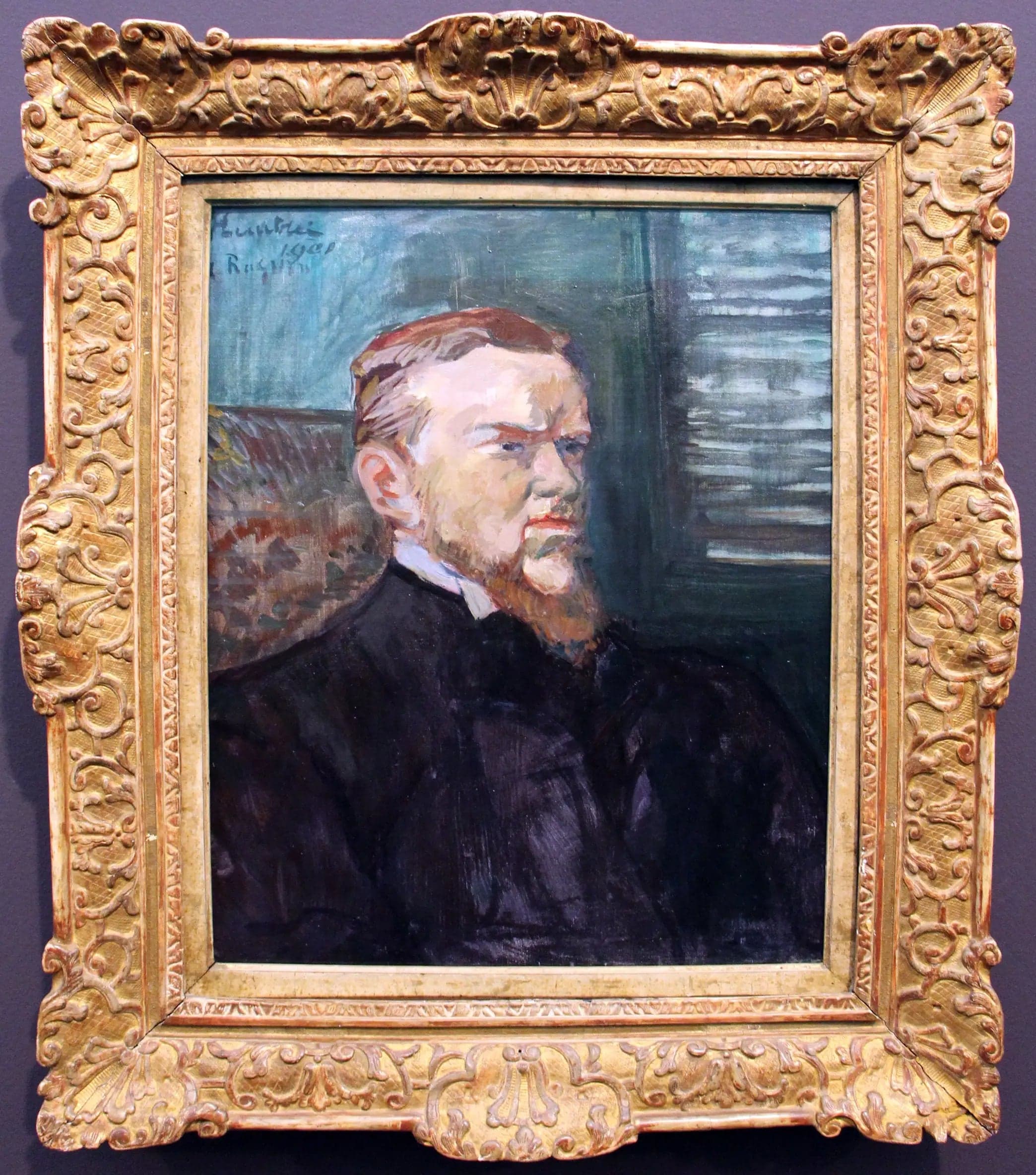
Octave Raquin - Henri de Toulouse
- Original dimensions
- 46 x 56 cm
- Museum
- São Paulo Museum of Art
- Year
- 1901
Scene depicted
"Octave Raquin" transports us to a fleeting moment of human existence, revealing the complexities of emotions in the face of the ordinary. We discover a man motionless, lost in thought, enveloped in an atmosphere of silent melancholy, which Toulouse-Lautrec manages to capture with disconcerting finesse. Each brushstroke becomes a contemplative exploration of solitude and introspection.
Historical context
Created in 1901, the painting "Octave Raquin" is set in the vibrant context of the Belle Époque in Paris, a golden age of art where Impressionism and Post-Impressionism were redefining the pictorial landscape. While Toulouse-Lautrec lingered on cabarets, this canvas reveals a psychological and social depth, now exhibited at the São Paulo Museum of Art . With its 46 x 56 cm, this canvas testifies to the excellence of an artist whose talent will continue to inspire generations.
Place in the artist's career
This painting marks a crucial point in Toulouse-Lautrec's career, presenting a more intimate style than his other iconic works such as "At the Moulin Rouge" and "La Goulue." In "Octave Raquin," the artist explores a more melancholic register, highlighting an artistic maturity emerging at this time, alongside his Parisian nocturnal adventures. This canvas reveals a turning point towards a more tactile humanity.
Anecdote
Henri de Toulouse-Lautrec once declared: "Every face tells a story, but some resonate with our own quest." This quote could apply to the inspiration behind "Octave Raquin," where a face, perhaps that of a friend encountered at a bistro, stirs within us buried memories, echoes of ordinary past transformed into a masterpiece .