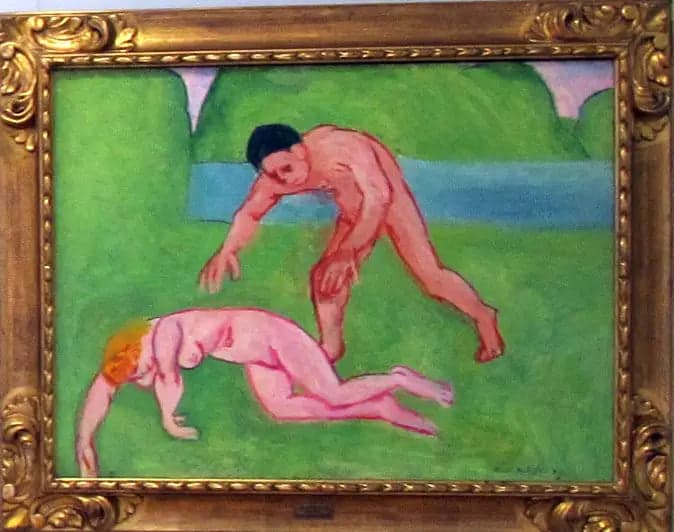
Nymph and Satyr
- Original dimensions
- 117 x 89 cm
- Museum
- Hermitage Museum
- Year
- 1908
Scene depicted
In this canvas , Matisse delicately depicts a moment of intimacy between a Satyr and a Nymph, symbols of a wild and natural love. The lush background evokes a vibrant nature, while the characters seem captured in a hypnotic dance, connecting the sky and the earth. This timeless composition captures the essence of mythology and celebrates the beauty of existence.
Historical context
Created in 1908, this painting emblematic of Henri Matisse finds its roots in the Fauvist movement, a bold current that advocates the liberation of color. This canvas is currently exhibited at the Hermitage Museum , where it is preserved as a treasure of modern art. Matisse's painting is part of a pivotal period in the history of art, where personal expression takes precedence over realistic representation.
Place in the artist's career
The painting Nymph and Satyr represents a turning point in Matisse's career, an early success that heralds later collaborations and anthologies of modern art. Comparable to his masterpiece "The Dance" and "The Joy of Life," this painting reflects his stylistic evolution, oscillating between conventional rigidity and sincere freedom.
Anecdote
Henri Matisse once stated: "Color is the instrument of my emotion." It was on a spring morning, bathed in soft light, that the idea for this pictorial work came to him. A walk among wildflowers awakened a deep inspiration within him, capturing the very essence of the painting he wished to create. Thus, each brushstroke becomes a note of a colorful orchestra, a vibrant visual melody.