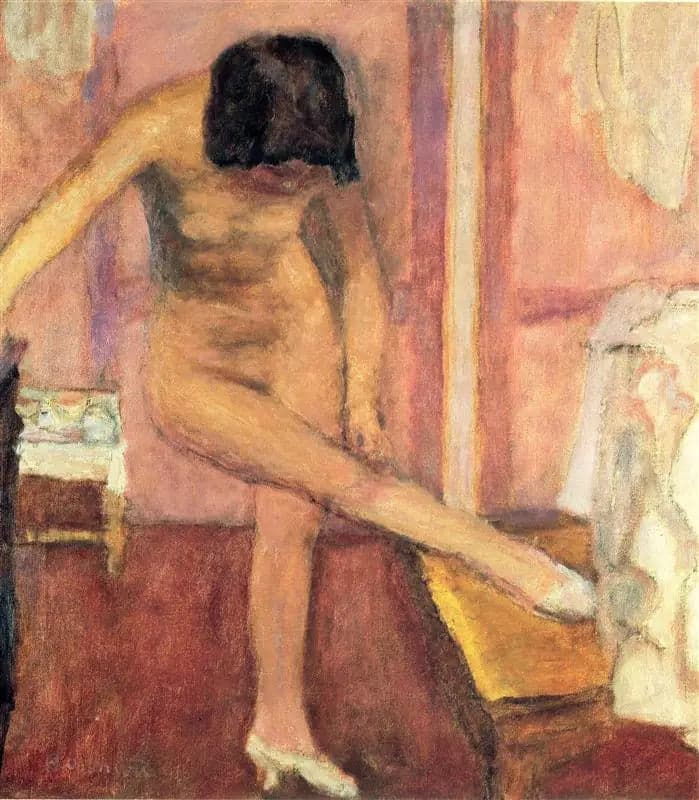
Nude Woman Bending
- Original dimensions
- 57.1 x 52.7 cm
- Museum
- Tate
- Year
- 1923
Scene depicted
In this painting , Bonnard captures a woman in a gesture of submission to the light. The softness of her posture, refined and vulnerable, evokes a scene of almost silent intimacy. The composition reveals a moment of grace, inviting the viewer to appreciate the serenity of this floating instant. The forms intertwine in a visual dance that speaks of human relationships and artistic daily life.
Historical context
Created in 1923, this iconic work by Pierre Bonnard finds its origins in Paris, a city bubbling with creativity that witnessed the birth of the neo-impressionist movement. Far from being a mere representation, Nude Woman Bending embodies the fusion of post-impressionist influences. Currently housed at the Tate , this painting measures 57.1 by 52.7 cm, a format that invites an intimate immersion into the scene's intimacy.
Place in the artist's career
Nude Woman Bending represents a peak in Bonnard's career, marking a maturation of his colorist style. Echoing works like The Terrace at Vernon and The Bathers , this painting testifies to the transition from a limited approach to a broader exploration of the intimate and the everyday. Here, the technique liberates itself and flourishes in an unprecedented play of light.
Anecdote
“Beauty lies in the light captured on the canvas,” Bonnard passionately said. On a spring morning, inspired by the play of light in his studio, he was carried away by the elegance of a simple movement. This fleeting moment sowed the seeds of this masterpiece , where the female body becomes an ode to natural beauty.