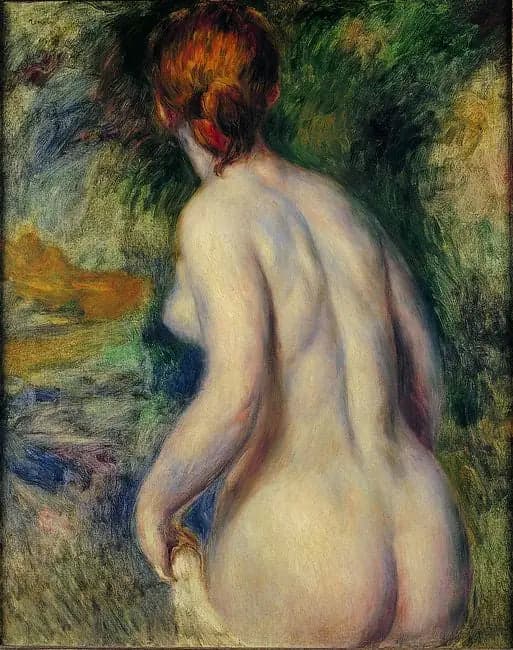
Nude Seen from Behind - Pierre
- Original dimensions
- 66 x 81 cm
- Museum
- Tel Aviv Museum of Art
- Year
- 1881
Scene depicted
In this painting , Renoir invites us to contemplate the natural grace of a female silhouette, seen from the back, set in a soft and soothing atmosphere. The light, like a delicate caress, envelops the body, while the play of shadows subtly highlights the contours. It is a work that transcends mere representation to touch the very essence of beauty.
Historical context
Born in the year 1881, this painting is an iconic work that unfolds into a singular composition characteristic of the Impressionist movement, which flourished in Paris. Nude Seen from the Back reflects an era where light and movement are celebrated on canvas, emanating from Renoir's studio, located in the vibrant city of Paris. His majestic canvas currently resides at the Tel Aviv Museum of Art , preserved from the ravages of time.
Place in the artist's career
This canvas , both a culmination and a witness of a prolific period of creation, is situated at a pivotal moment in Renoir's career. At this time, the artist had already asserted his unique style found in other iconic works such as Lunch of the Boating Party and The Large Bathers , from the same period. Here, the modernity of visual impressions combines with a mastery of color and light, paving the way for bolder work.
Anecdote
“The light dances on the skin, just like a gentle whisper of spring.” This quote, although likely invented, evokes Renoir's inspiration: a bright morning where nature slowly awakens, revealing the beauty of a female body imbued with serenity. The evocative power of Nude Seen from the Back lies precisely in this captured intimacy, this resplendent visual poetry.