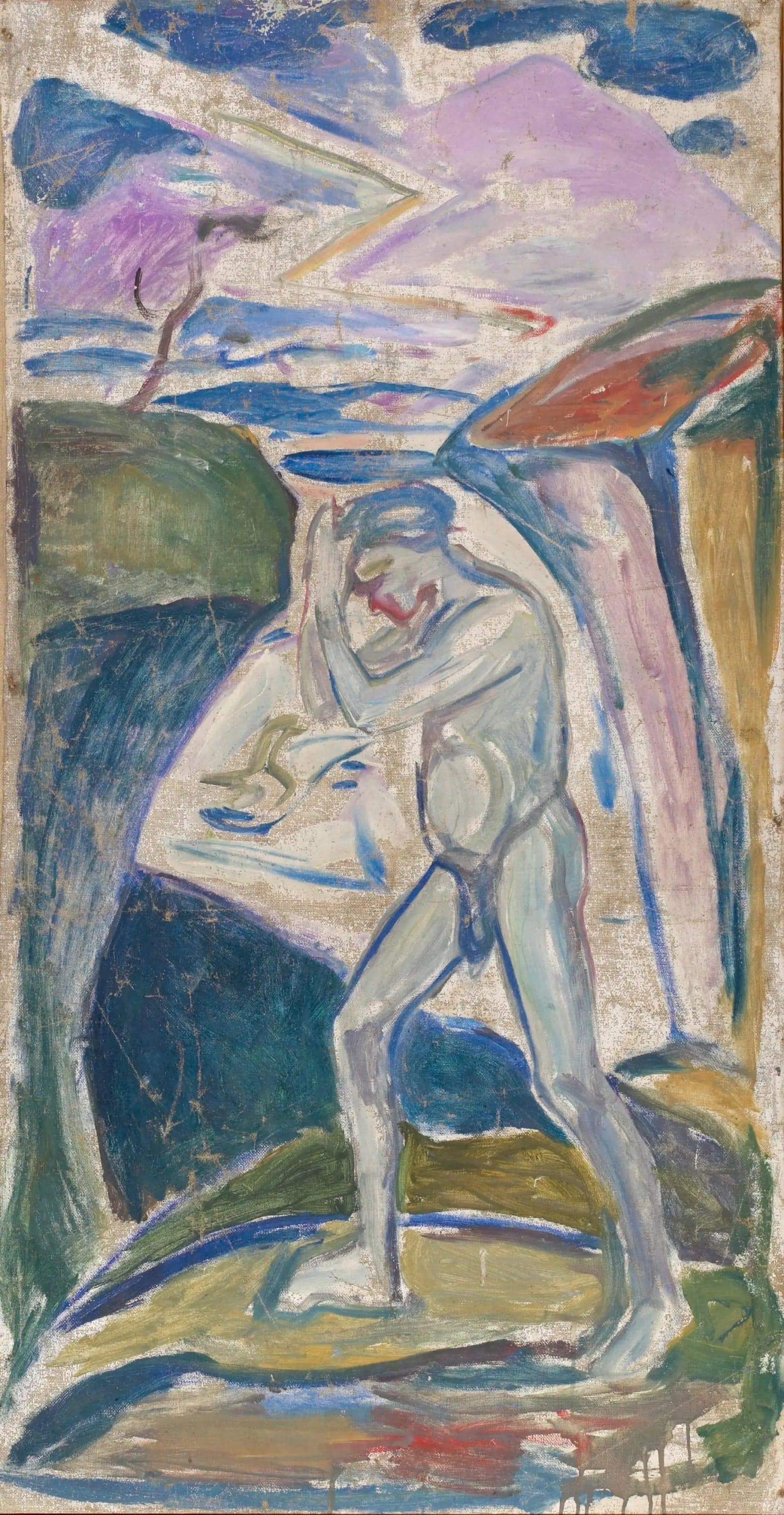
Nude Man in a Rocky Landscape
- Original dimensions
- 66.5 x 127 cm
- Museum
- Munch Museum
- Year
- 1926
Scene depicted
In this painting , the nude body seems to emerge from the stone, frozen in a chaotic landscape. The contrast between living flesh and rough rocks evokes a dialogue between nature and man, where the fragility of the human condition confronts the power of the natural world, creating an atmosphere that is both serene and disturbing.
Historical context
Created in 1926, this painting is emblematic of Edvard Munch and is located in Oslo, Norway. Inscribed in the expressionist movement, the canvas captures the essence of an era marked by questions about existence and human nature. The painting is currently part of the collections of the Munch Museum, where it continues to fascinate visitors with its impressive dimensions.
Place in the artist's career
Nude Man in a Rocky Landscape represents a key element in Munch's evolution. Located towards the end of his career, this painting dialogues with previous works such as The Scream, where anxiety is palpable, and The Dance of Life, which celebrates emotions. The treatment of forms and colors here reveals a stylistic maturity, testifying to an evolution towards a more liberated abstraction.
Anecdote
“Every painting is a cry of the soul.” said Munch, thus evoking the depth of his inspiration. On a misty spring morning, while he was drawing near the rocks of the fjord, the face of a nude model captivated his gaze. This fleeting encounter transformed into emotion immortalized in this masterpiece , testifying to the struggle between beauty and the vulnerability of the human being.