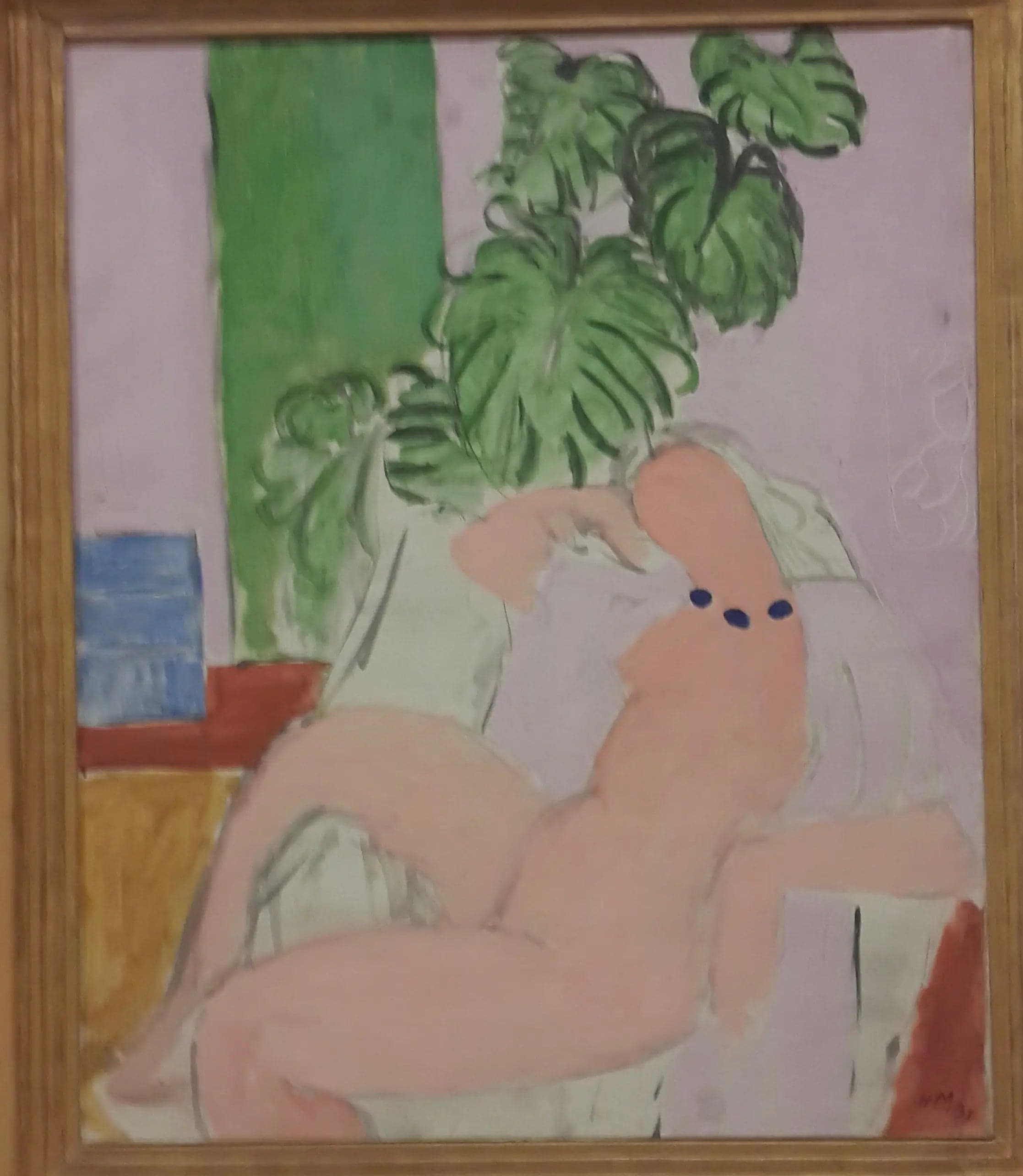
Nude in an Armchair, Green Plant
- Original dimensions
- 60.5 x 72.5 cm
- Museum
- Matisse Museum
- Year
- 1936
Scene depicted
This canvas reveals an intimate scene, where the silhouette of a nude lounges languidly in an armchair, enveloped by the softness of a green plant. The composition is an invitation to relaxation, a dialogue between the human figure and the plant world, signifying harmony between man and nature.
Historical context
Created in 1936, this iconic painting by Henri Matisse represents a crucial moment in the Fauvist movement, where color and form transcend conventional boundaries. This painting was created in a Paris vibrant with creativity, a city at the heart of an era of artistic transformation. The canvas is currently exhibited at the Matisse Museum, serving as a testament to the master's influence on subsequent generations.
Place in the artist's career
This painting is part of a rich creative period for Matisse, illustrating his liberation from conventions. Compared to works such as The Dance and The Woman with the Hat , Nude in a Armchair, Green Plant represents a stylistic evolution marked by the bold exploration of color and form.
Anecdote
“Color is a force that can illuminate the soul,” said Matisse, recalling a summer morning when he observed the play of light in his home. It is in this atmosphere that the inspiration for Nude in a Armchair, Green Plant awakened, capturing the magic of a moment suspended between serenity and contemplation.
Major exhibitions
Matisse. Art Notebooks, the Turning Point of the 1930s