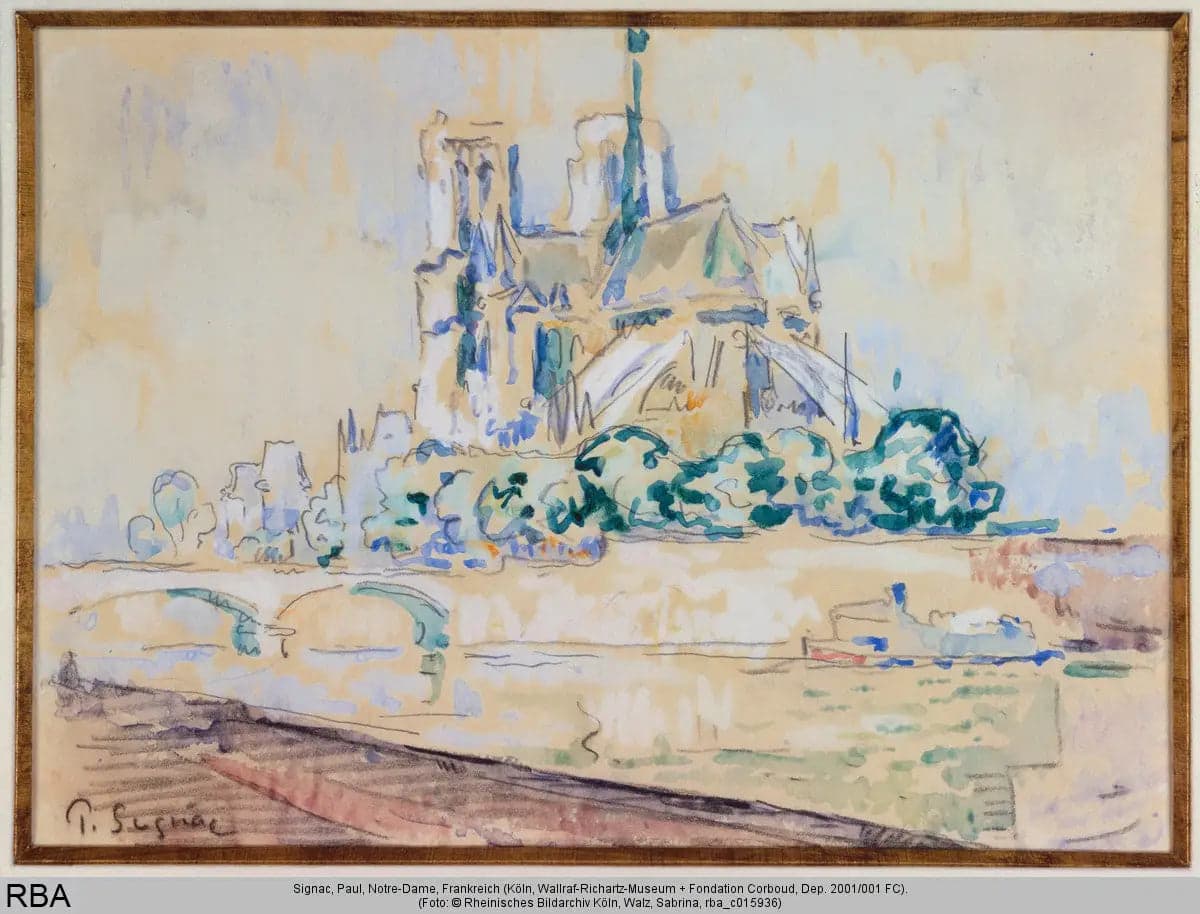
Notre-Dame
- Original dimensions
- 25.5 x 18.4 cm
- Museum
- Wallraf-Richartz Museum
- Year
- 1920
Scene depicted
The vibrant scene depicted in this painting highlights the brilliance and grandeur of Notre-Dame, especially at dusk, when the orange hues of the setting sun reflect on its stones. This painting does not merely represent a monument; it invites the viewer to feel the atmosphere imbued with mystery and the sacred that surrounds this historical symbol.
Historical context
Created in 1920 in the city of Cologne, this painting is emblematic of the Neo-Impressionist movement, an artistic trend that revolutionized the perception of colors and lights. Through this canvas , Paul Signac offers us a poetic vision of the Notre-Dame cathedral, a symbol of Gothic architecture that radiates its majesty in the heart of the city. Today, this painting is preserved at the Wallraf-Richartz Museum , where its brilliance inspires admiration from visitors.
Place in the artist's career
This painting from 1920 marks a turning point in the career of Paul Signac , where his ingenious mastery of color reaches a brilliant maturity. Alongside “ Le Port de Saint-Tropez ” and “ Portrait of Félix Fénéon ”, “Notre-Dame” is part of a series of paintings that testify to the evolution of his technique, highlighting his reinvention of pointillism through broader and more expressive strokes.
Anecdote
“On an April morning, under the gentle rays of the sun, I felt an immeasurable inspiration in the face of the beauty of Notre-Dame. Each brushstroke had to evoke the song of lights and the harmony of this vast architecture,” Signac might have declared while contemplating his subject. This quote resonates strongly in the creation of this masterpiece , taking the artist away from urban turmoil to a spiritual and sensory experience.