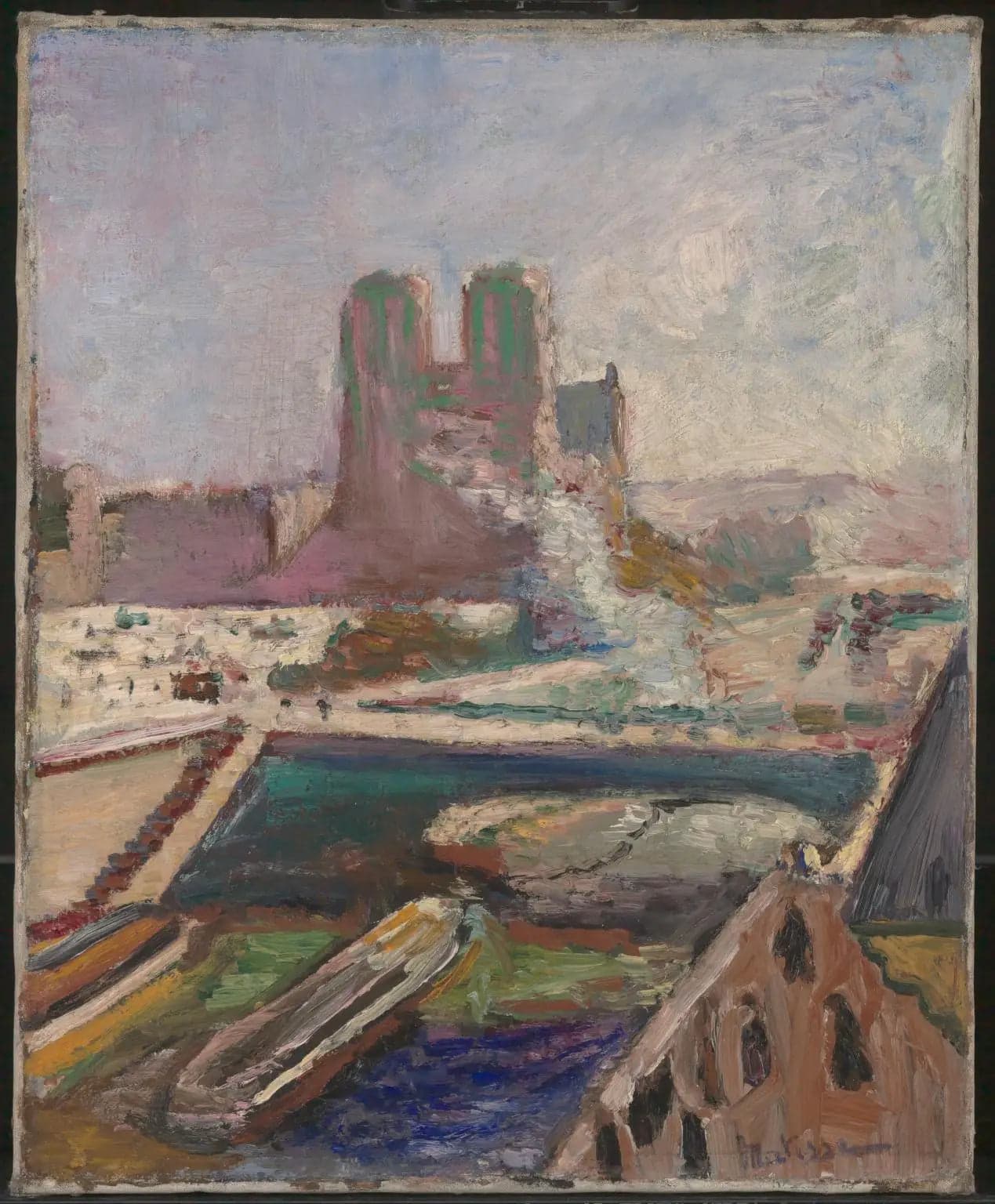
Notre-Dame
- Original dimensions
- 56.4 x 46.2 cm
- Museum
- Moderna Museet
- Year
- 1905
Scene depicted
This painting captures a unique vision of the Notre-Dame cathedral, not merely as a monument, but as a living entity, enveloped in emotions and stories. Matisse's bold brushstrokes bring the structure to life, each hue participating in an unprecedented harmony. The sky is tinted with vibrant shades, while the cathedral's walls seem to breathe to the rhythm of the artist.
Historical context
Created in the heart of Paris, this painting is emblematic of the Fauvist movement, an artistic effervescence thriving at the beginning of the 20th century. In 1905, Matisse broke free from conventions, embracing color and light like never before. This canvas , currently displayed at the Moderna Museet in Stockholm, reflects the transition between impressionism and a modern vision of art.
Place in the artist's career
Notre-Dame marks a major turning point in Matisse's career, representing the fusion of his innovative approach to color and light. Compared to his paintings "La Luxe" and "La Danse," this painting shows a maturation in his style and his ability to evoke the depth of human emotions.
Anecdote
Henri Matisse once stated: "Color is an essential element that transcends reality." It is in a vibrant atmosphere, perhaps on a sunny morning near the Seine, that the vision of Notre-Dame imposed itself on him. The dancing shadows and shimmering light blend in this pictorial work , nourishing the heart of the creation of the masterpiece .